# Android: The Most Used Linux in the World
- **Published on:** 2026-09-16
- **Category:** News
- **Original page:** https://linuxgratis.com/en/articles/android-the-most-used-linux
Android runs on the Linux kernel across billions of devices, yet it is not GNU/Linux. Learn why, its history, and how it really relates to Linux.
---
Say "Linux" and most people picture servers, desktop distributions, or a terminal full of green text on a black screen. Yet the most widespread operating system built on the Linux kernel doesn't live on a PC at all. It lives in your pocket. That would be [Android](/en/android), running on roughly 3.9 billion active devices worldwide and holding around 72% of the global mobile operating system market.
## A history that began with a startup acquisition
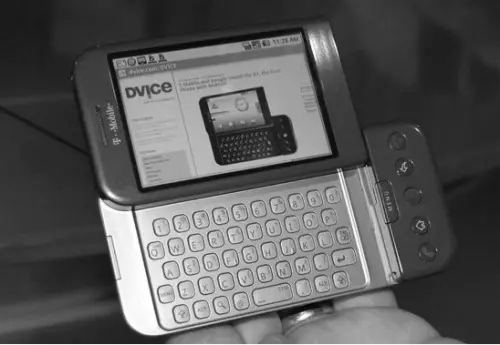
The HTC Dream (T-Mobile G1), the first Android phone, with its signature sliding physical keyboard. · Imagen: Luis Alberto Arjona Chin / CC BY 2.0 · Wikimedia Commons
Android started life as an independent company, Android Inc., founded by Andy Rubin and his team. Google bought it in July 2005 to build a software platform for mobile devices. The deal looked minor at the time, but it went on to shape the mobile strategy of the entire industry.
The first commercial Android phone arrived in October 2008: the HTC Dream, sold in the United States as the T-Mobile G1. That device, with its sliding physical keyboard, kicked off an expansion that turned Android into the dominant operating system on the planet in little more than a decade.
## Yes, it uses the Linux kernel
Here's the technical heart of the matter. Android uses the Linux kernel, the very same project maintained by the global community that you can explore in our [Linux kernel](/en/linux-kernel) profile. It isn't an imitation or a "half Linux." At its core beats a real Linux kernel, adapted for the mobile world.
Google starts from LTS (Long Term Support) kernel versions and applies device-specific patches to build what are called Android Common Kernels (ACKs). Each Android generation maps to a kernel branch. Android 16 uses version 6.12, while Android 14 worked with the 6.1 or 5.15 branches. Memory management, hardware drivers, process scheduling, networking: Linux handles all of it, exactly as it does in [Ubuntu](/en/ubuntu) or [Debian](/en/debian).
## But it is not GNU/Linux
And here's the nuance many people miss. The fact that Android uses the Linux kernel does not make it a GNU/Linux distribution. Classic distros like [Fedora](/en/fedora) or [Arch Linux](/en/arch) pair the kernel with the GNU toolset: the glibc standard C library, the coreutils, bash, and that whole base.
Android skips almost all of it. Instead of glibc it uses **Bionic**, Google's own C library derived from BSD code, far lighter and tuned for mobile CPUs. The traditional GNU coreutils are gone too, replaced by a slimmed-down toolbox (toolbox/toybox). And where a distro runs native system binaries, Android runs apps on top of **ART** (Android Runtime), an environment that compiles application bytecode to speed up execution.
That's why the precise statement is: Android is Linux, but it is not GNU/Linux. It shares the heart, not the skeleton.
## The layers that make up Android
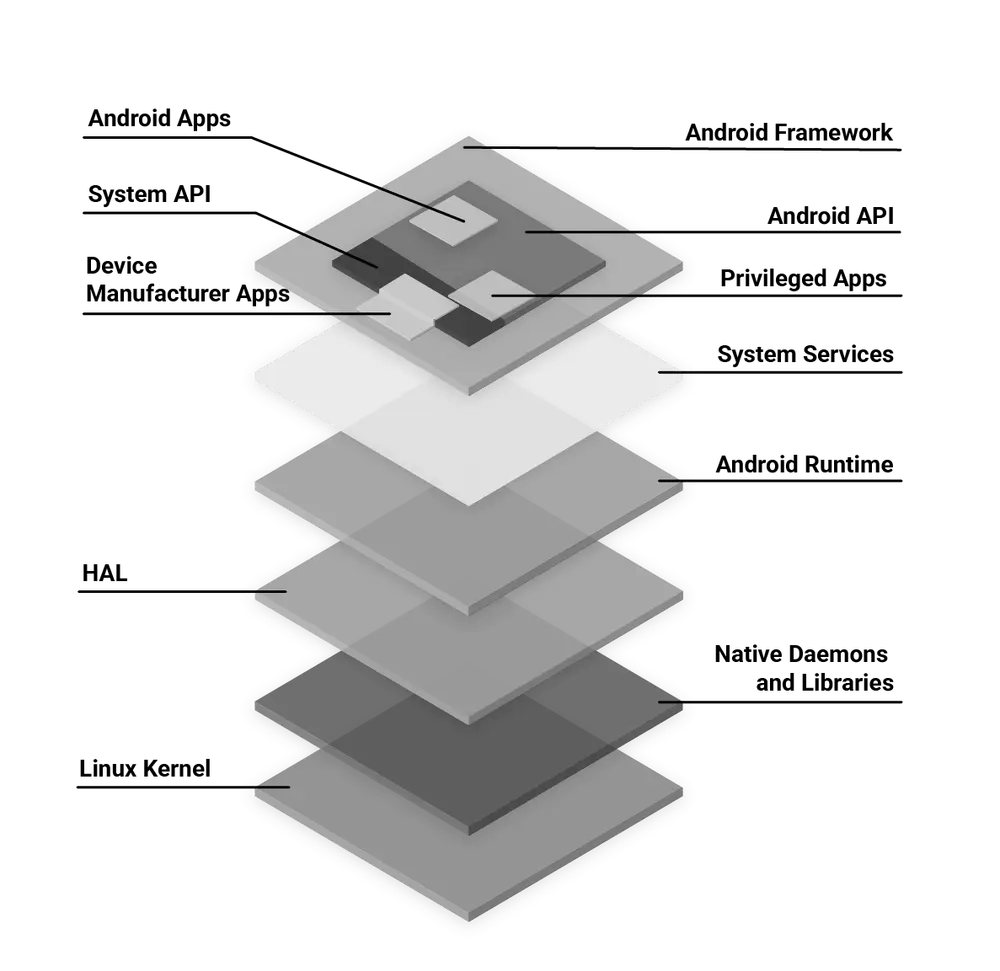
The Android stack layers: on top of the Linux kernel sit the HAL, the runtime, the libraries, the framework and the apps. · Imagen: Google / CC BY 2.5 · Wikimedia Commons
To grasp the difference, it helps to look at how Android is organized in layers:
- **Linux kernel**: the foundation that talks to the hardware (drivers, power, security, networking).
- **HAL (Hardware Abstraction Layer)**: an abstraction layer connecting a manufacturer's specific hardware to the upper layers without touching the kernel.
- **Runtime and libraries**: ART, Bionic, and native libraries (graphics, multimedia, databases).
- **Application framework**: the APIs developers use to build apps.
- **Applications**: what you see and touch on the screen.
Thanks to this modular design, the same system runs on phones, tablets, TVs, watches, and cars.
## AOSP: the open core
A large part of Android is free software. The base project is called **AOSP** (Android Open Source Project) and ships mainly under the Apache 2.0 license. Anyone can download the code, study it, modify it, and build their own system.
That's where alternative ROMs come from. The best known is [LineageOS](/en/lineageos), heir to the historic CyanogenMod, which keeps phones alive long after their manufacturers have given up on them. Other projects bring "real" Linux to phone hardware, such as [postmarketOS](/en/postmarketos), and the line between the mobile world and traditional distributions keeps getting blurrier.
One thing to keep in mind: the commercial Android on most phones also bundles Google Mobile Services (Play Store, Maps, etc.), which are proprietary and not part of AOSP.
## Why it is "the most used Linux"
If you count how many systems running the Linux kernel are working right now around the world, desktop distributions like [Linux Mint](/en/linuxmint) or [Pop!_OS](/en/pop-os) add up to millions of enthusiastic users. Android dwarfs them by several orders of magnitude. Billions of people use Linux every day without knowing it, each time they unlock their phone.
That's the paradox: the most invisible Linux is also the most popular. It has no green terminal and no apt package manager, yet it shares the same core that powers half the internet's servers. Android didn't make Linux mainstream through the desktop. It did it through the pocket, and along the way it earned the title of the most used Linux in the world.