# UNIX: the operating system that started it all (1969)
- **Published on:** 2026-06-23
- **Category:** News
- **Original page:** https://linuxgratis.com/en/articles/history-of-unix
Before Linux, before BSD, before macOS there was UNIX. The story of the system born in 1969 that laid the foundations of almost every modern operating system.
---
Your phone, your laptop, the servers delivering this very page: almost everything you touch every day descends, one way or another, from an operating system born more than half a century ago. Its name is **UNIX**. That's not nostalgic exaggeration from old sysadmins. It's quite literally the family tree of modern computing. And it all started with a handful of engineers, a machine nobody wanted, and the urge to do things differently.
## 1969: the year that changed everything
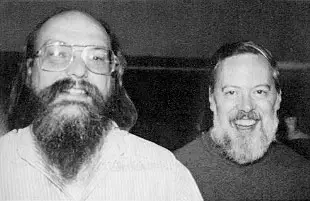
Ken Thompson (standing) and Dennis Ritchie in 1973, the fathers of UNIX at AT&T's Bell Labs. · Imagen: Unknown authorUnknown author / Public domain · Wikimedia Commons
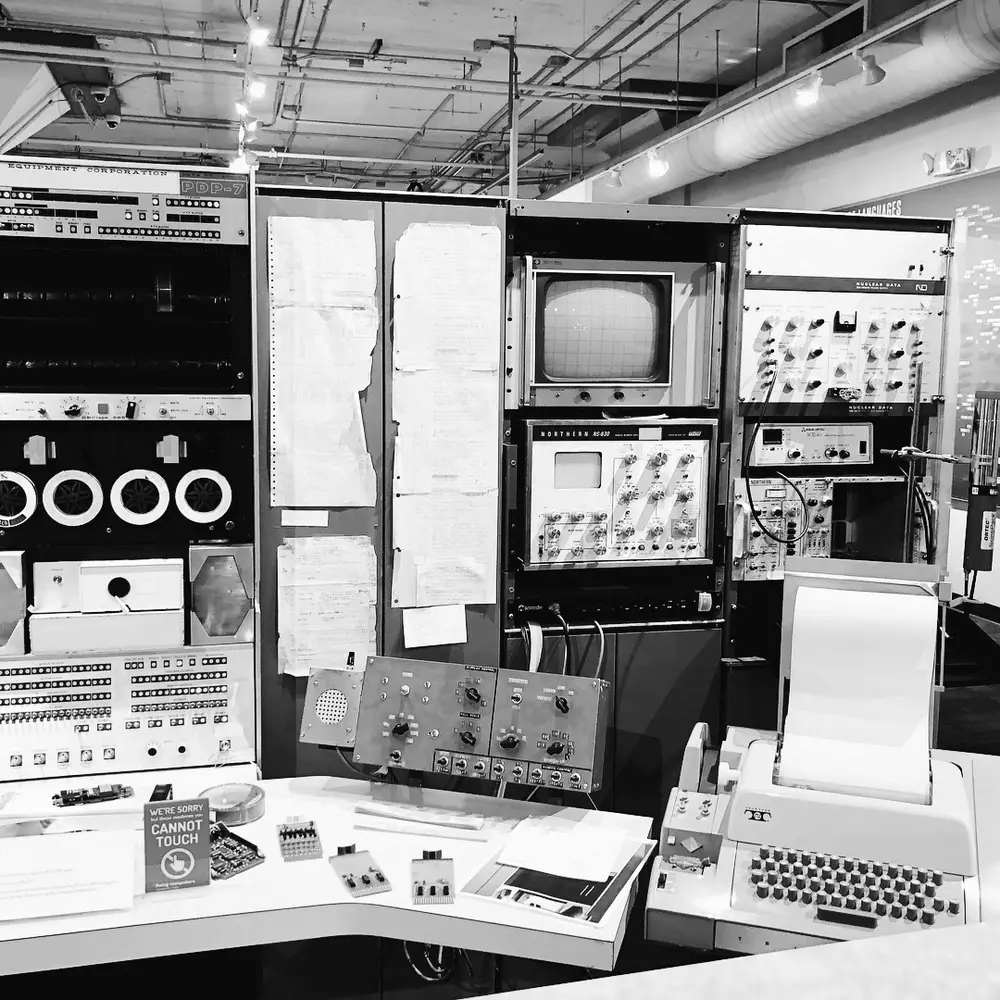
In 1969, at AT&T's **Bell Labs**, **Ken Thompson** used a stretch of free time to write a simple, elegant operating system. He built it on a barely used **PDP-7** minicomputer, hand-coding a file system, a process scheduler and a rough command interpreter in assembly language. **Dennis Ritchie** joined soon after, and the two of them laid down the foundations for everything that came next.
The name itself is a joke. The team had just come off **Multics**, an ambitious project that collapsed under its own weight. Brian Kernighan suggested **Unics** as a pun, and over time it settled into **Unix**. The same year humans walked on the Moon, the software that would quietly run computing for decades was being born.
## The UNIX philosophy: do little, but do it well
What really set UNIX apart wasn't the code, but a **philosophy** that holds up just as well today as it did then. Doug McIlroy, another Bell Labs pioneer, boiled it down to a few ideas that anyone who has ever opened a terminal will recognize at once:
- Write programs that do **one thing and do it well**.
- Make programs that **chain together and cooperate**, feeding the output of one into the input of the next through *pipes* (`|`).
- **Everything is a file**: devices, processes and data are all handled with the same tools.
That combinable simplicity is why typing `cat file | grep error | sort | uniq` still feels natural half a century later. UNIX never handed you monolithic giants. It gave you small parts and the freedom to bolt them together however you liked.
## C: the language that made UNIX immortal
To write UNIX, Dennis Ritchie created the **C** language around 1972. Then, in **1973**, the team took the decisive step and rewrote the UNIX kernel itself in C rather than assembly. For the time it sounded like heresy, since everyone assumed a serious operating system had to be written in assembly. It changed history anyway.
The payoff was enormous. Written in a high-level language, UNIX became **portable**. Moving it to a new machine no longer meant rewriting it from scratch; you just recompiled the code. C, by the way, is still one of the most widely used languages on the planet half a century later, and it sits at the heart of the [Linux kernel](/en/linux-kernel) and nearly every system that matters today.
## The tree that grew from UNIX
A DEC PDP-7, the spare minicomputer model on which UNIX was born in 1969. · Imagen: ComputerGeek7066 / CC BY-SA 4.0 · Wikimedia Commons
By the late 1970s UNIX was already moving through universities and corporations. **Version 7** (1979) was the last major release of the research line, and from there the tree split into two great lineages that shaped the decades to come:
- The **commercial AT&T** branch: System III (1982) and then **System V** (1983), which gave rise to enterprise UNIX systems like [Solaris](/en/oracle-solaris), IBM's [AIX](/en/ibm-aix) and HP-UX.
- The **Berkeley** branch (BSD), born at the University of California, which evolved into the modern [FreeBSD](/en/freebsd), [OpenBSD](/en/openbsd) and [NetBSD](/en/netbsd). Through this branch, by way of NeXTSTEP, UNIX's DNA reached [macOS](/en/macos) and, with it, [iOS](/en/ios) and hundreds of millions of devices.
So that all these variants could understand one another, **POSIX** appeared, the standard published in 1988 that defines what it means to be "UNIX-compatible." And here comes the most famous guest of all: **Linux**. Linus Torvalds' kernel contains **not a single line of original UNIX code**, yet it is a *UNIX-like* system that copies its design, its commands and its philosophy. From it descend [Debian](/en/debian), [Ubuntu](/en/ubuntu), [Fedora](/en/fedora) and the rest of the distributions you'll find across this directory.
## A legacy that never expires
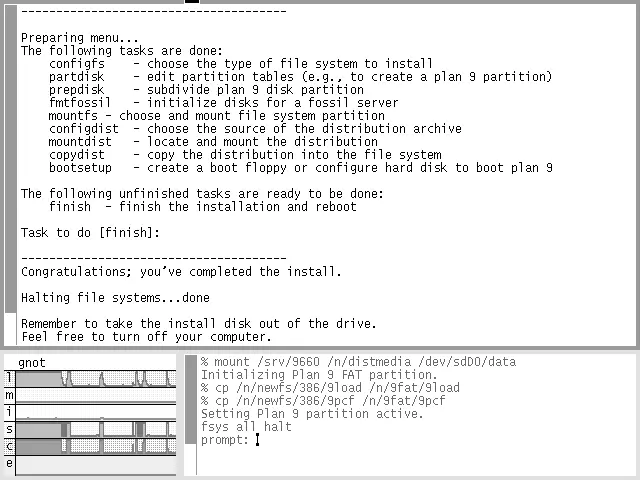
Plan 9 from Bell Labs, the free operating system with which UNIX's creators tried to reinvent their own work. · Imagen: Software: Bell Labs/Lucent Technologies/Plan 9 Foundation Screenshot: VulcanSphere / MIT · Wikimedia Commons
The same authors tried to outdo their own work with **Plan 9**, an experimental successor that pushed "everything is a file" to its absolute limit. It never caught on commercially, but it left behind things we use daily without noticing, such as the **UTF-8** encoding (created by Ken Thompson and Rob Pike) and the `/proc` file system.
That is UNIX's real monument: not a product you can buy today, but an **invisible grammar**. Every time you open a terminal, chain commands with `|`, spin up a server or type `ls`, you are speaking a language designed in 1969. UNIX isn't just history. It's the quiet foundation the digital world still runs on.