# The History of Windows: From MS-DOS to Windows 11
- **Published on:** 2026-09-21
- **Category:** News
- **Original page:** https://linuxgratis.com/en/articles/the-history-of-windows
A journey through the history of Windows: from MS-DOS to Windows 1.0, 95, NT, XP, 7, 10 and 11, the NT kernel, Windows Server and WSL alongside Linux.
---
Few software products have shaped personal computing as deeply as Windows. What started as a graphical layer bolted onto a command-line system grew into the most widely used desktop on the planet. Let's walk through how that story unfolded, the technical decisions that actually mattered, and how Windows relates to the Linux world today.
## From MS-DOS to the first window
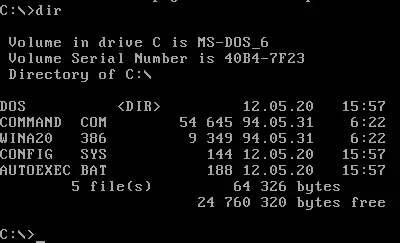
MS-DOS, the command-line system on top of which Windows 1.0 ran. · Imagen: Ms-dosdir.png Przemub (talk) derivative work: ויקיג'אנקי / Public domain · Wikimedia Commons
Before Windows existed, IBM PCs and their clones ran MS-DOS, a system driven entirely by typed commands. Microsoft announced Windows in November 1983 and shipped **Windows 1.0 on November 20, 1985**. It wasn't a standalone operating system but a graphical environment running on top of MS-DOS, with a file manager, Notepad, a calculator, and even a game, Reversi, meant to help people get comfortable with a mouse that felt almost futuristic at the time.
The reception was lukewarm. Many praised the ambition, but the software was slow and demanded too much from the hardware of the day. Even so, it laid the groundwork for everything that came next.
## Windows 3.1 and the boom of the 90s
Windows 95 introduced the Start menu and the taskbar, elements that still endure today. · Imagen: OS: Microsoft Corporation Files: BetaWiki-Beitragende / Public domain · Wikimedia Commons
The next releases refined the idea. **Windows 3.0 (1990) and Windows 3.1 (1992)** were the first to reach mass adoption and cemented Microsoft as the leader in consumer software. The interface got better, TrueType fonts arrived, and the application catalog grew fast.
The defining leap came with **Windows 95**, released on August 24, 1995. It brought features that are still with us three decades later: the Start menu, the taskbar, and Windows Explorer. Under the hood it still carried plenty of 16-bit code inherited from Windows 3.1, but for users it was a revolution in both looks and usability.
## The NT branch: a brand-new kernel
While the "9x" branch (95, 98, and Me) kept evolving on aging foundations, Microsoft was working in parallel on something far more ambitious. In 1988 it hired **David Cutler**, an engineer who came from Digital Equipment Corporation (DEC) and the mind behind the VMS operating system. Cutler led the development of an entirely new kernel, solid and built for servers and professional environments.
The result was **Windows NT 3.1, released on July 27, 1993**. Its resemblance to VMS was so striking that DEC and Microsoft eventually reached a financial settlement. That NT architecture, with true multitasking and security by design, is the foundation of every modern Windows. Over time, the NT family absorbed and replaced the 9x branch entirely.
## XP, 7, 10 and 11: the modern era
Unification arrived with **Windows XP**, released on October 25, 2001, which brought the solid NT kernel to mainstream home users and became famous for its longevity. After the troubled Windows Vista, **Windows 7 (October 22, 2009)** restored confidence with a stable, polished system.
Next came **Windows 10 on July 29, 2015**, framed as an operating system "as a service" with continuous updates, and finally **Windows 11 on October 5, 2021**, with a centered visual redesign and stricter hardware requirements. Against that backdrop, free alternatives such as [Ubuntu](/en/ubuntu), [Linux Mint](/en/linuxmint), and [Fedora](/en/fedora) became serious desktop options for anyone after a different model.
## Windows Server: the professional side
The NT kernel was never just for the desktop. It also gave rise to **[Windows Server](/en/windows-server)**, the product line built for data centers, enterprise directories, web servers, and network services. For years it has competed head to head with systems like [Debian](/en/debian), [RHEL](/en/rhel), and [AlmaLinux](/en/almalinux) in the server market, where Linux dominates many segments but Windows holds a strong position in corporate environments built around Active Directory.
## WSL: when Linux came to Windows
The most symbolic gesture of reconciliation between the two worlds came in 2016. At the Build conference, Microsoft unveiled the **Windows Subsystem for Linux (WSL)**, initially branded "Bash on Ubuntu on Windows" and available in the Anniversary Update on August 2, 2016. For the first time, a real [Linux](/en/linux-kernel) environment could run inside Windows without a virtual machine.
In 2019, Microsoft announced **WSL 2**, a redesigned architecture with a genuine Linux kernel running inside a lightweight virtual machine. Today WSL lets developers run distributions like [Ubuntu](/en/ubuntu), [Debian](/en/debian), and [Kali](/en/kali) alongside Windows, an idea that was unthinkable during the era of open rivalry.
## A legacy that lives on
From that first window in 1985 to today's integration with Linux and the cloud, Windows has reinvented itself without fully breaking from its past. Its story is also the story of personal computing: the shift from the command line to the mouse, and a rivalry with [Linux](/en/linux-kernel) and [macOS](/en/macos) that, far from fading away, now coexists on the very same machine.