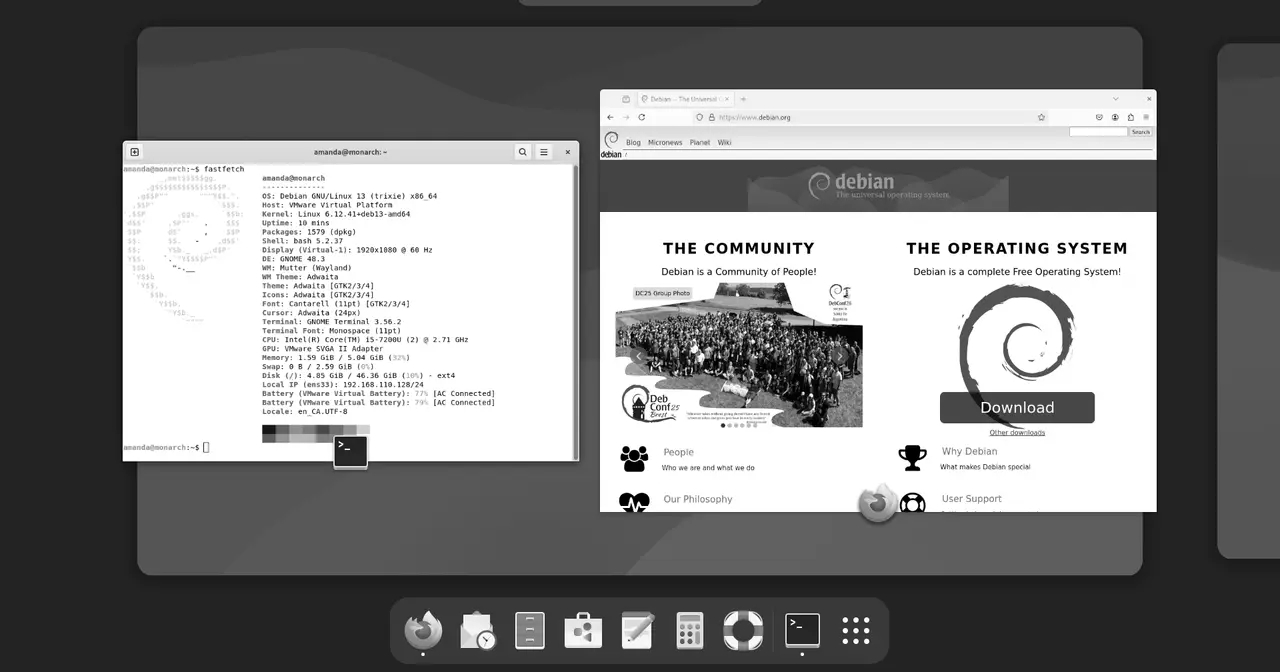
The Debian Project announced Debian 13, code name “trixie”, on August 9th, 2025, after two years, one month and thirty days of development. It is the new stable release of one of the oldest and most influential GNU/Linux distributions. Ubuntu is built directly on top of it, and it remains a benchmark for servers, desktops and embedded systems all over the world.
Debian is a free operating system built by thousands of volunteers under the Debian Social Contract. It puts stability, security and a strong commitment to free software first, which makes it a solid choice if you run servers and need long-term reliability, or if you just want a robust, predictable desktop.
Here are the highlights of Debian 13 “trixie”:
- Linux kernel 6.12 LTS, improving support for recent hardware and power management.
- Updated desktop environments: GNOME 48, KDE Plasma 6.3, Xfce 4.20, LXQt 2.1.0 and LXDE 13.
- Official support for the riscv64 architecture for the first time, so Debian now runs on 64-bit RISC-V hardware.
- Migration to a 64-bit time_t ABI on all architectures except i386, which addresses the year 2038 problem.
- Updated software stack: GCC 14.2, LLVM/Clang 19, OpenSSL 3.5, PHP 8.4 and Python 3.13.
- A catalogue reaching 69,830 packages, with more than 14,100 new and 44,326 updated.
This release also improves reproducible builds and ships expanded manual page translations. With this version, the i386 architecture is no longer supported as a regular architecture: there is no official kernel or installer for those systems, and “trixie” will be the last release to support armel.
As usual with Debian, “trixie” will be maintained for five years thanks to the combined work of the Debian Security team and the Long Term Support (LTS) team. That makes it an ideal base for production deployments that need extended support.
You can find all the details, requirements and downloads on the Debian page on LinuxGratis.
Source