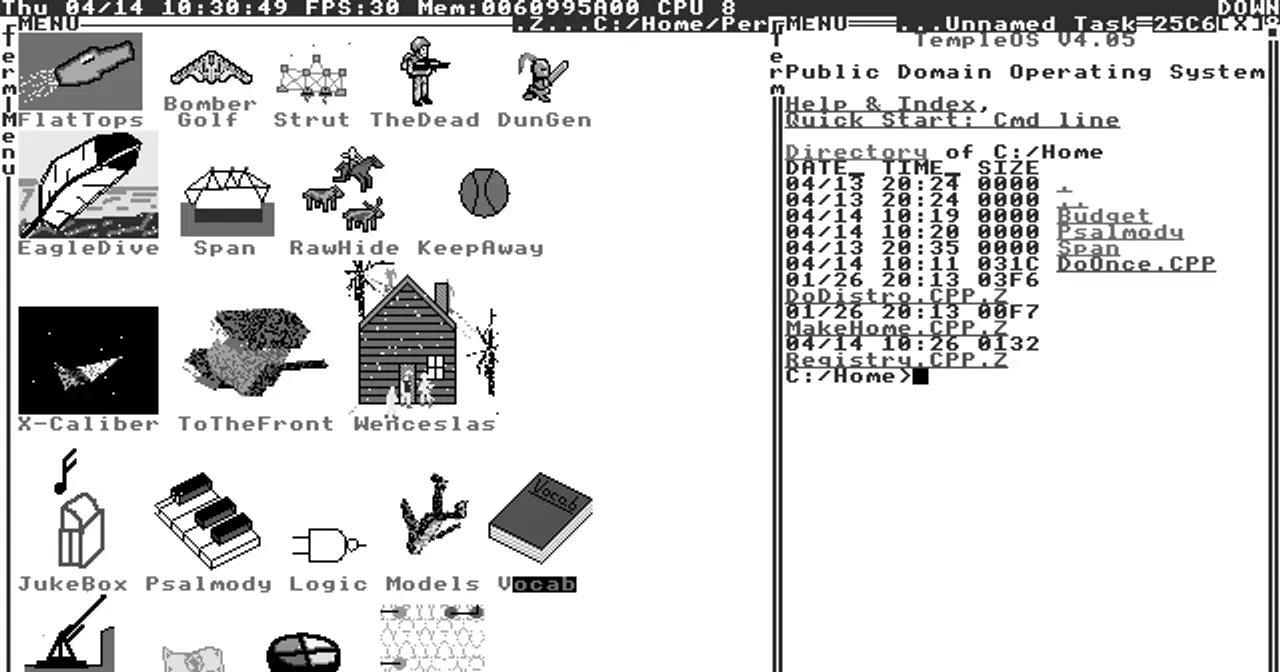
Some operating systems are born in huge corporations, with thousands of engineers and budgets running into the millions. Then there is TempleOS, written from start to finish by one person over more than ten years. It is not the fastest, the most useful or the most secure system ever made. But few projects in the history of computing manage to be this fascinating, this moving and this baffling all at once. This is the story of Terry A. Davis and the operating system that, according to him, God commissioned.
A programmer and an impossible idea
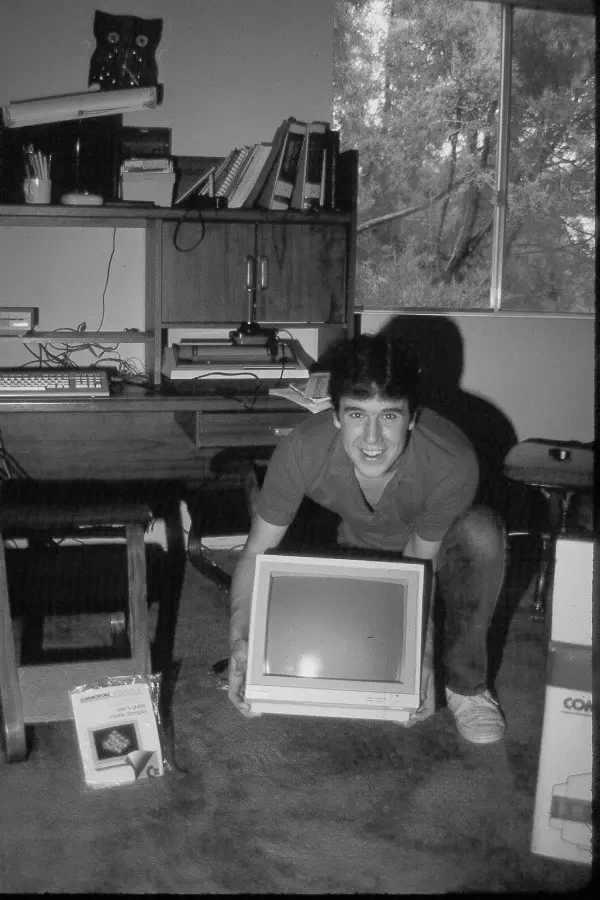
Terrence Andrew Davis (1969-2018) was an American electrical engineer and programmer with rare technical talent. He started building what would later become TempleOS around 1993, after a series of manic episodes that he described as a divine revelation. Davis lived with schizophrenia, and his biography is shaped as much by his brilliance as by his illness.
He never set out to compete with Windows or with distributions built on the Linux kernel. Davis wanted to build the “Third Temple” described in the Hebrew Bible, but as software: a place where, he said, people could commune with God through their computer. That premise, half theology and half low-level code, makes TempleOS one of a kind.
From LoseThos to TempleOS
The project changed its name several times. Its earliest version was called the J Operating System, with a first public release (version 2.0) in 2005, handed out from Davis’s personal website. In 2006 it became LoseThos, a nod to a scene from the film Platoon (1986).
Later the system took the name SparrowOS, until in March 2013 it was finally christened TempleOS for good. Version 5.03, considered the last official release, arrived in November 2017. That adds up to more than a decade of solo work, with no team and no company behind it.
What TempleOS looks like under the hood
Inside, TempleOS is spartan on purpose, almost a tribute to the era of home computers. Davis himself called it a “modern Commodore 64”. Here are its most striking features:
- A fixed 640x480 resolution with 16 colors and single-voice audio. Davis claimed God requested these specifications explicitly.
- The HolyC language, which he built as a middle ground between C and C++, just-in-time compiled. It works as both a programming language and the system shell.
- A 64-bit, ring-0-only architecture: there is no kernel-user separation, so everything runs with maximum privileges.
- Non-preemptive cooperative multitasking: tasks have to yield control of their own accord.
- No network drivers: TempleOS does not connect to the internet by design.
Davis also held himself to a self-imposed cap of 100,000 lines of code for the whole system. The final version lands at roughly 80,000 lines and includes the kernel, the 64-bit compiler, the 2D and 3D graphics libraries and every tool. Seen that way, it is a stunning piece of minimalist engineering.
The “oracle” and other curiosities
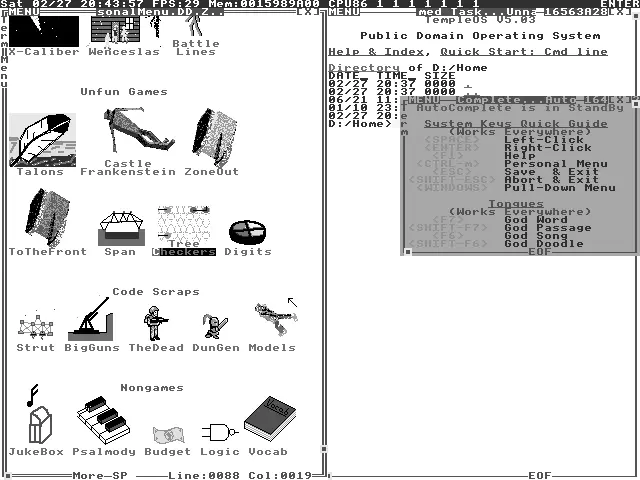
One of its best-known features is the oracle. TempleOS shipped with a tool that generated pseudorandom text from an internal stopwatch; Davis compared it to a Ouija board or to glossolalia, and used it to “talk to God”. A single keystroke produced a stream of words that he read as divine messages.
The system also let you draw inline graphics next to text, mixing code and art in an unusual way. Its documentation, the DolDoc files, combined text, images and executable links in a single hypertext format.
TempleOS shares the spirit of small, educational systems like MINIX or the experimental Plan 9, yet its strangeness sets it apart from any direct comparison. It was never meant for production but, in Davis’s own words, for “recreational programming”.
An unexpected legacy
Terry A. Davis died in August 2018, in tragic circumstances after years of mental health struggles and periods of homelessness. After his death, the community of programmers who had followed his videos and posts for years reclaimed his memory, not without controversy, as that of a misunderstood genius.
Today TempleOS survives as public-domain software and still draws study, tributes and forks. Beyond the religious dimension and the illness, one technical fact is undeniable: a single man wrote a complete operating system, with its own language and its own compiler, from scratch. It is a feat we will most likely never see again.