
Few Linux distributions have shaped how we ship software as much as Alpine Linux. The funny part is that it was never built for the cloud. It started out on routers and embedded devices. This is the story of how a tiny distro became the foundation for millions of containers around the world.
An embedded beginning in 2005
Alpine Linux first appeared in August 2005, created by Natanael Copa, its founder and lead maintainer. The project drew directly from the LEAF Project (specifically the Bering-uClibc branch) and GNAP, and in its early days it leaned on Gentoo. The goal was plain from the start: build a small, fast and secure operating system for resource-constrained hardware such as wireless access points and routers.
That embedded DNA shaped every design decision that came after. While distributions like Debian and Ubuntu chased convenience and a huge package catalogue, Alpine went the other way and installed only what was strictly necessary.
The pieces that set it apart
Alpine’s big technical bet is swapping the usual GNU components for far lighter alternatives. Instead of glibc, it uses musl libc, a clean and compact take on the standard C library. In 2014 Alpine made a significant move by switching from uClibc to musl, which locked that philosophy in for good.
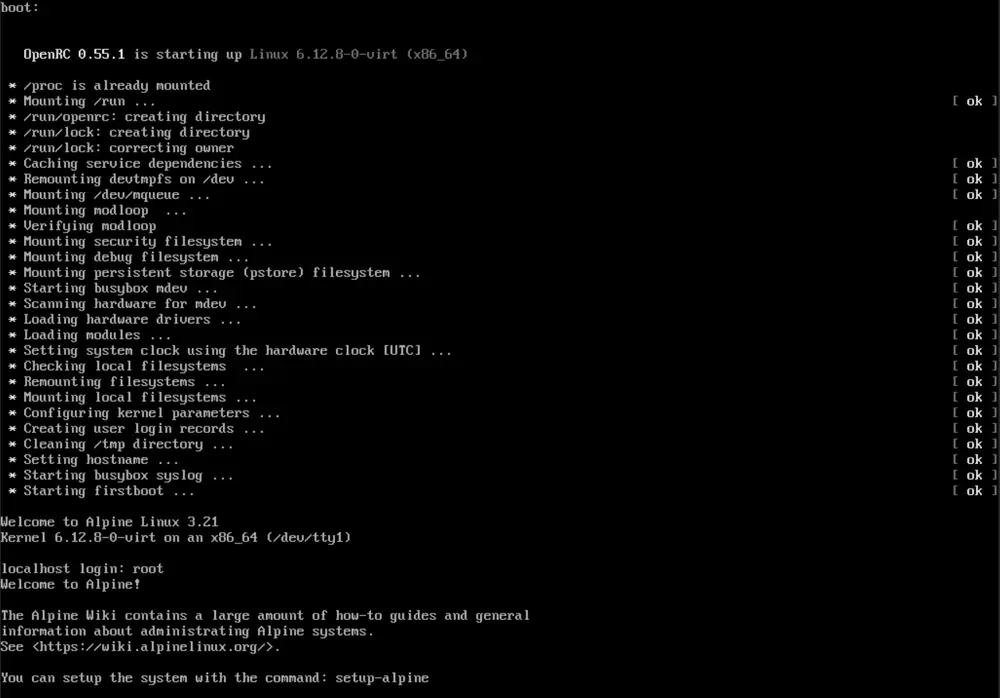
Rather than the GNU Core Utilities, Alpine relies on BusyBox, a single executable that packs the basic command-line tools (ls, cd, cp and dozens more) into just a few kilobytes. And where most modern distributions use systemd, Alpine keeps OpenRC, a simple and predictable init system.
To manage software it ships its own package manager, apk (Alpine Package Keeper), known for its speed, concise syntax and minimal resource use. That combination of musl, BusyBox, OpenRC and apk is exactly what lets a base install stay tiny and boot in an instant.
Security baked in from day one
Another defining trait throughout Alpine’s history has been its focus on security. For years the kernel was compiled with the PaX and grsecurity patches, which added memory-hardening protections rarely seen in general-purpose distributions. The grsecurity situation changed over time, but that hardening culture stuck with the project.
This mindset puts Alpine in the same conversation as systems built for sensitive environments like Tails or Qubes OS, though Alpine chases security from a different angle: shrinking the attack surface by stripping away everything superfluous. Less installed code simply means fewer things that can break or be exploited.
The container moment

The real turning point came with the explosion of Docker. From 2015 onward, developers started hunting for the smallest possible base images to speed up deployments and cut storage and transfer costs. Alpine fit perfectly: its official image weighs roughly 5 MB.
The contrast with other bases is dramatic. An Alpine image hovers around 5 MB, while Ubuntu starts at about 64 MB, Debian at over 100 MB, and options like CentOS topped 200 MB. For anyone building microservices and spinning up dozens of containers, those savings pile up fast.
Between 2015 and 2018 Alpine gained serious traction in the container world, eventually becoming one of the most pulled images on Docker Hub and a common base for Kubernetes deployments. The “alpine” and “slim” variants of countless official images were born precisely to cash in on this minimalist approach.
What Alpine taught the wider ecosystem
Alpine’s success proved something that sounded backwards: sometimes doing less is the smarter call. Its approach influenced how other distributions think about size and modularity, and it keeps good company with equally minimalist projects like Void Linux, TinyCore and antiX, each with its own recipe for staying light.
It is not a distro for everyone. Using musl instead of glibc can cause incompatibilities with software written for classic GNU environments, and BusyBox offers slimmed-down versions of many tools. But for containers, embedded systems and any scenario where size and boot time matter, Alpine remains hard to beat.
A story still being written
More than two decades after those first routers, Alpine Linux keeps its essence intact while moving along with the rest of the Linux world. Recent releases have widened hardware support and desktop environments, which shows that minimalism doesn’t mean standing still. The next time you pull a tiny container image, there’s a good chance Alpine is quietly doing the work underneath, true to the idea it was born with: do just enough, do it well and take up as little space as possible.