
Few distributions inspire as much loyalty as Arch Linux. For many users it marks the end of a long trip through Linux: the moment you stop avoiding the command line and start enjoying it. Behind its reputation as a demanding system sits one simple, powerful idea that has steered the project for more than two decades: keep everything as simple as possible. Here we trace how Arch was born, who created it, and why the KISS philosophy still defines its character.
The origin: Judd Vinet and 2002
Arch Linux was born in March 2002, created by Judd Vinet, a Canadian programmer who was unhappy with the distributions of his day. He admired the elegance and cleanliness of minimalist projects such as CRUX, but he wanted a powerful package manager that could resolve dependencies on its own. So instead of settling, he set out to build his own distribution from scratch.
The first public release, Arch Linux 0.1, appeared on 11 March 2002. The name was no accident. Vinet liked the meaning of “arch” as “the principal” or “the chief”, the same root found in words like “arch-enemy”. From day one, Arch aimed to be a solid, unadorned foundation on which each user could build exactly the system they needed.
Pacman: the heart of the project
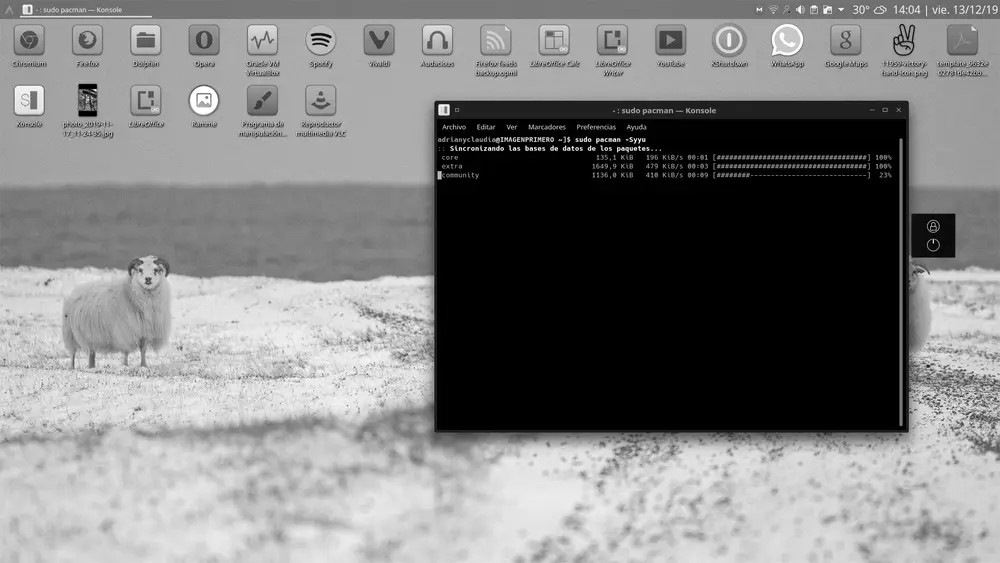
One of Vinet’s biggest contributions was pacman, the package manager he wrote specifically for Arch. Pacman installs, updates and removes software while sorting out dependencies on its own, with a direct syntax and impressive speed. While other distributions such as Debian relied on APT, or Fedora on RPM, Arch had its own lightweight tool, built to fit its philosophy.
Pacman was later joined by the Arch User Repository (AUR), which arrived in April 2005. The AUR is a community-driven repository of build scripts that lets users install almost any program imaginable, from proprietary software to niche projects that would never reach an official repository. Today it is one of Arch’s biggest draws and one of the reasons its software catalogue feels nearly endless.
Rolling release: a system always up to date
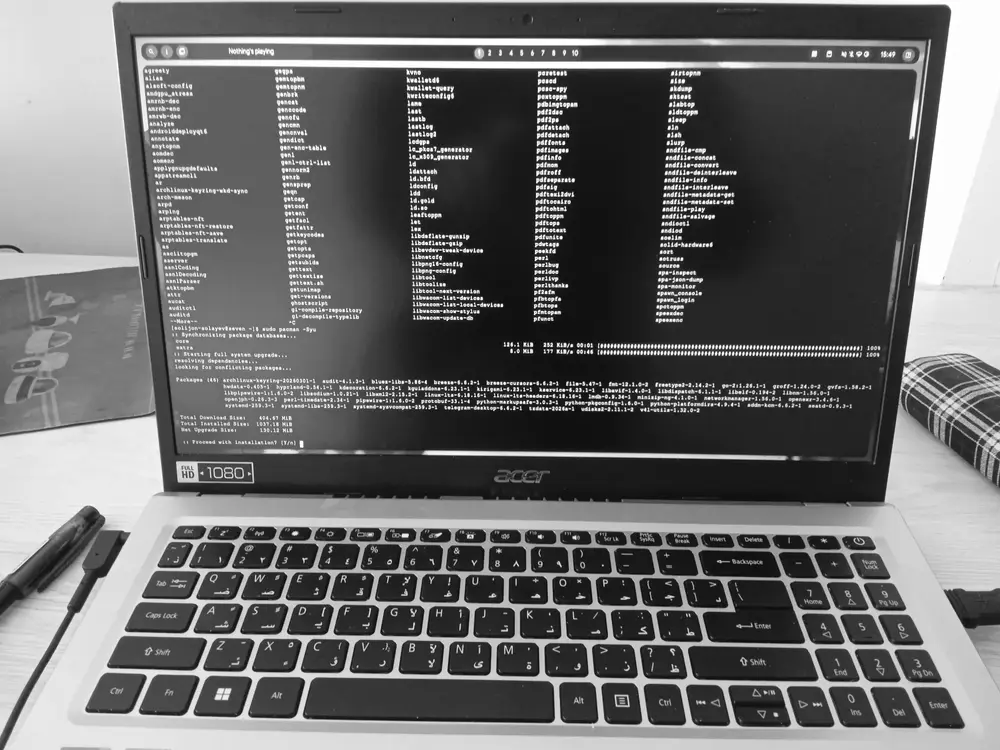
Arch brought the rolling release model to a wide audience. Unlike distributions with numbered versions and fixed support cycles, Arch has no “versions” as such: the system updates continuously. A single command gives you the latest versions of the kernel, applications and libraries, with no need to reinstall everything every few years.
The upside is obvious, since you get the newest software the moment it lands, and in return it asks for some attention from you: you have to maintain the system and read the notices before updating. Many other distributions would later adopt or adapt the model, and it shapes the experience of anyone who prefers to live on the cutting edge.
The KISS philosophy, explained
The soul of Arch is the KISS principle: “Keep It Simple, Stupid”. It is worth understanding well, because people often misread it. KISS does not mean “easy for beginners”; it means “simple in design”. Arch steers clear of layers of abstraction, graphical wizards that add nothing and distribution-specific changes to the original software. The aim is to deliver software exactly as its authors publish it, with no middleman.
That philosophy gave rise to the manual installation that earned Arch its reputation for years: the user partitions the disk, configures the network and chooses every component. That process was no quirk but a statement of intent. Since April 2021 the official images include archinstall, a guided installer that simplifies the initial setup without giving up the control that defines the distribution.
Community, ArchWiki and leadership
If pacman is the technical heart of Arch, the ArchWiki is its collective brain. This community-maintained documentation has become so thorough that even users of other distributions, such as Ubuntu or openSUSE, turn to it. Solving a problem on Arch usually begins and ends on its wiki.
As for leadership, Vinet led the project until 1 October 2007, when he handed control to Aaron Griffin for lack of time. Under Griffin came milestones such as mandatory cryptographic signing of the repositories in 2011. In February 2020, Griffin in turn passed leadership to Levente Polyak, keeping the tradition of an orderly handover alive.
The legacy: Manjaro, EndeavourOS and beyond
Arch’s influence reaches far beyond its own users. Distributions built on its foundation bring that power to a broader audience. Manjaro, created in 2011, adds its own repositories, graphical tools and a curated update process for a more comfortable experience. EndeavourOS, which emerged in 2019 as the spiritual successor to Antergos, instead stays very close to pure Arch, pulling straight from its repositories alongside a friendly installer.
More than twenty years on, Arch Linux remains faithful to the idea it was born with. It does not try to win over everyone; it offers a clean, transparent and always-current base to those who want to understand and control their system. That consistency, more than any single feature, explains why the Arch community keeps growing with such passion.