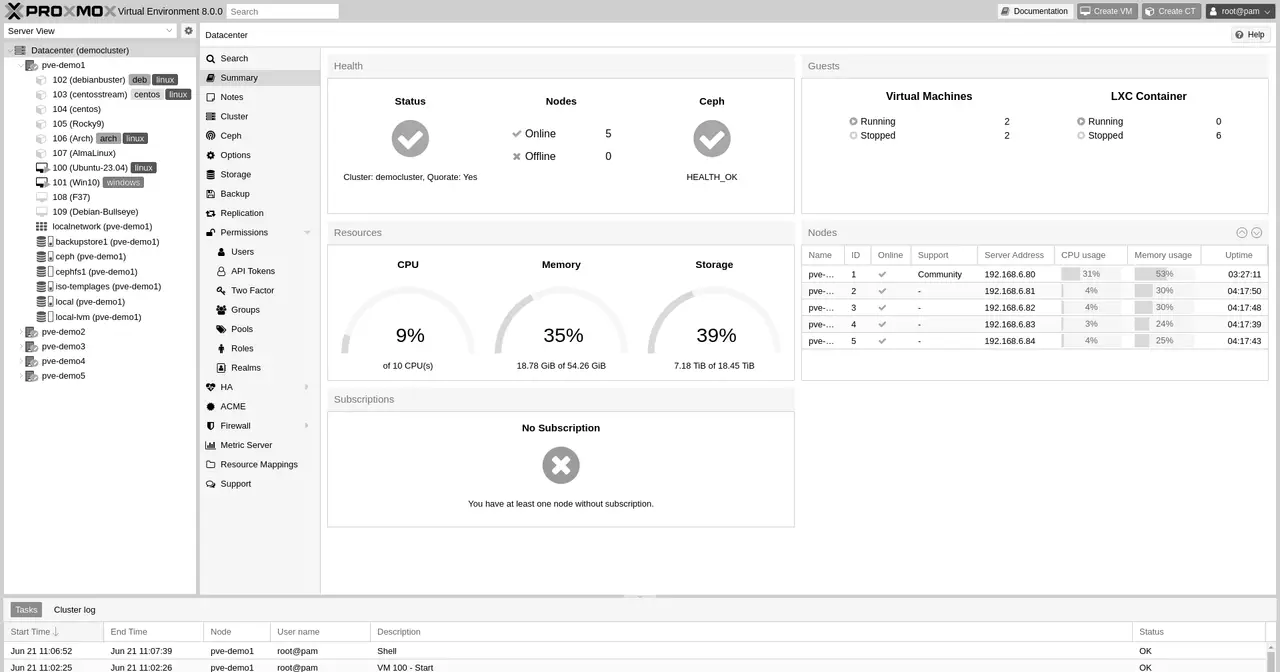
On 22 June 2023 Proxmox released Proxmox VE 8.0, the first of the 8 series and the one that changes its foundation: from Debian 11 to Debian 12 “Bookworm”, with kernel 6.2 as the stable default.
What is underneath
- QEMU 8.0.2, LXC 5.0.2, ZFS 2.1.12 and Ceph Quincy 17.2.6.
- A tested upgrade path from Proxmox VE 7.4, which is the supported way to get here: from 7.4 to 8.0, not in jumps.
Resource mapping, which is the important part
The change that really alters how a cluster is run is resource mapping: PCI(e) and USB devices can be defined as an abstract resource, managed from the API and the web interface, and matched to the concrete devices on each node.
It sounds like a configuration detail and it is not. Until now, a virtual machine with a card passed through to the guest was nailed to its node, because the device’s PCI path differed on every machine. With mapping, that VM can be migrated offline to another node holding an equivalent device. For anyone with GPUs or controllers passed through to VMs, this is the difference between being able to drain a node for maintenance and not.
Fine-grained permissions on software-defined networking
SDN resources — host network bridges and VNets — become objects in the access control system. Specific permissions can be granted on them to users and groups, instead of the previous all-or-nothing approach.
It is the kind of change only noticed by whoever shares a cluster between teams or customers, and there it is quite welcome.
How this version aged
Update, September 2026: the 8 series received four minor releases up to 8.4 (April 2025) and reached end of support on 31 August 2026. If you still run a cluster on 8.x, the route is upgrading to the 9 series, which sits on Debian 13. The dates for every version are on the Proxmox VE entry.
If the cluster in front of you is still VMware and that is why you are reading this, we have a guide to migrating from VMware to Proxmox with the phases and the details that bite. To do it with help, Migración Proxmox and Cloud Privado work on exactly that.
Source: Proxmox VE 8.0 press release.