
If you’ve wandered through our directory, you’ve probably bumped into something that throws off newcomers arriving from Windows or macOS: there isn’t one operating system here, there are hundreds. Sites like DistroWatch track a long list of active distributions, and new ones keep showing up. The question writes itself: wouldn’t one good distro be enough?
The short answer is that Linux is free software, and freedom breeds diversity. The longer answer is far more interesting, and it comes down to how a distribution is built and to a family tree that branches out from just a handful of roots.
A distro = kernel + everything else
First, let’s clear up a common mix-up. Linux, strictly speaking, is only the kernel, the core that talks to your hardware. On its own it’s useless for everyday work: no desktop, no browser, not even a convenient way to install programs.
A distribution is what turns that core into a system you can actually use. It takes the kernel and bundles it with everything you need:
- A package manager to install and update software.
- A desktop environment (GNOME, KDE Plasma, Xfce…) or, on servers, none at all.
- A set of default tools and applications.
- A specific configuration and a set of design decisions.
Since anyone can grab the kernel and assemble their own combination to suit a particular goal, the possibilities are nearly endless. That’s the seed of all the variety.
The Linux family tree
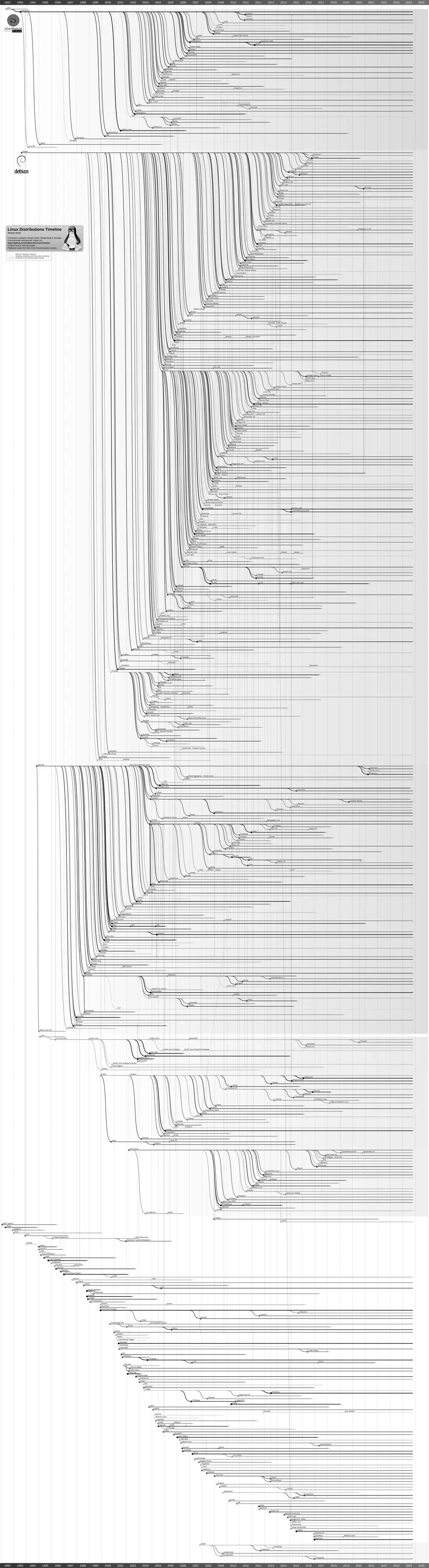
Even with hundreds of distros out there, almost all of them descend from a few “parent families.” Knowing them is the best way to find your bearings:
- Debian, founded by Ian Murdock in August 1993, is the largest family. Ubuntu was born from it in 2004, when Mark Shuttleworth and a group of Debian developers founded Canonical to build an easy-to-use desktop. And from Ubuntu, in turn, sprang Linux Mint, Pop!_OS and elementary OS. It’s a tree within the tree.
- Red Hat gave rise to Fedora (the community-driven cutting edge) and RHEL (the enterprise version). When Red Hat pivoted CentOS toward CentOS Stream in late 2020, the community responded by creating two binary-compatible RHEL rebuilds: Rocky Linux, led by Gregory Kurtzer (a co-founder of the original CentOS), and AlmaLinux, backed by CloudLinux. Both shipped their first stable releases in 2021.
- Arch, whose first release Judd Vinet put out in 2002 inspired by Slackware’s simplicity, is the base for Manjaro and EndeavourOS. Its
pacmanpackage manager and rolling-release philosophy have made it legendary among people who want total control. - Slackware, whose version 1.00 appeared in July 1993, is the oldest distribution still in active development. Minimalist and traditional, it finally received its long-awaited 15.0 release in 2026.
- openSUSE / SUSE was born in Germany: the company was founded in 1992 and was a pioneer in bringing Linux to the European enterprise world. Today openSUSE is loved for its YaST configuration tool.
Why so many: each one solves something different
The variety isn’t a whim. It answers real needs. Each distro makes different decisions precisely because it chases different goals:
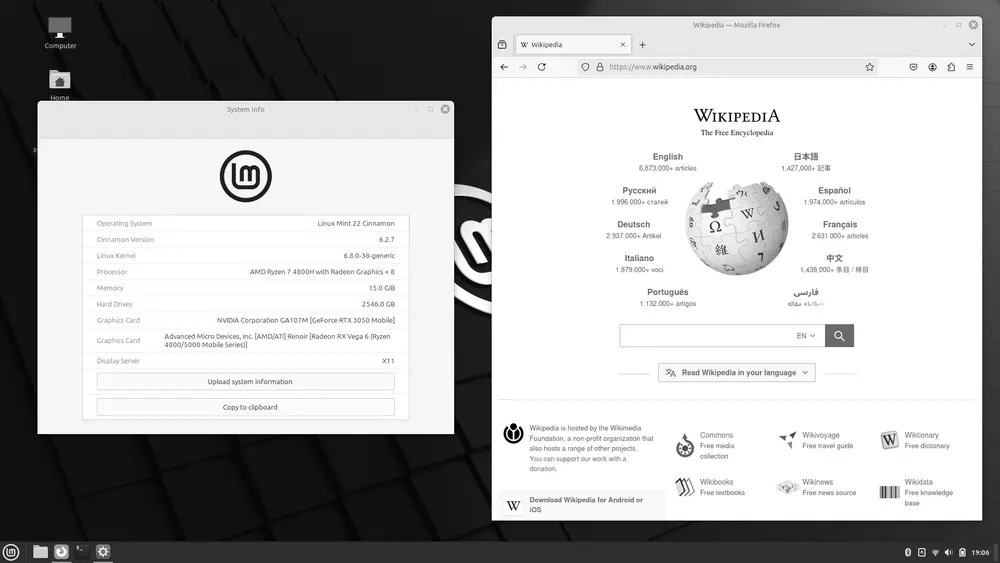
- Want an easy start? Ubuntu or Linux Mint, designed so anyone feels at home from the first boot.
- A stable, predictable server? Debian or Rocky Linux, where the priority is that nothing breaks.
- The bleeding edge? Arch or Fedora, which bet on recent versions of software.
- Reviving an old PC? A lightweight distro like antiX or Puppy Linux.
- Maximum privacy and anonymity? Tails, built to leave no trace, or Qubes OS, which isolates each task into compartments.
That same diversity explains why different package managers coexist: apt/dpkg in the Debian world, dnf/rpm in Fedora, pacman in Arch, or zypper in openSUSE. It isn’t chaos. It’s each family tuning its own way of working.
Variety isn’t a problem, it’s an advantage
People sometimes criticize this “fragmentation” as if it were a weakness, when it’s the very thing that keeps the system strong. The GPL license under which Linux is published guarantees a powerful right: the right to fork the project. If a distro makes a bad call, the community can take the code, walk away with it, and go another way. That’s what happened with Rocky and AlmaLinux after the CentOS shift.
That mechanism is the user’s best safeguard, because no single company controls the whole project. If some company tried to close down or degrade its distribution tomorrow, it couldn’t hold the community hostage, because the fork is always an option.
So don’t stress about hunting for “the best” distribution. There’s no single best one for everybody, just the best one for you and for whatever you want to do today. And if you change your mind, you can always install another. That freedom to choose, and to change your mind, is Linux too.