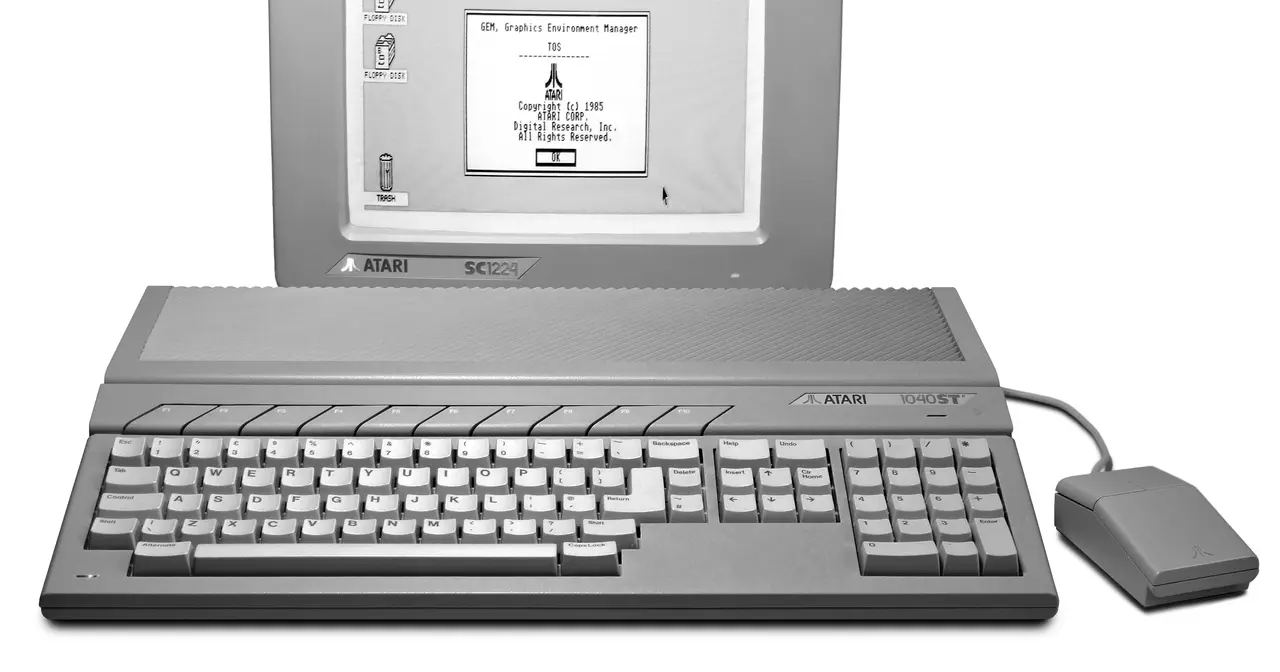
In the mid-1980s a quiet war played out on desktops around the world. On one side, the Commodore Amiga. On the other, the Atari ST, a machine built against the clock that ended up defining a whole generation of musicians, designers and enthusiasts. At its heart ran TOS, an operating system as pragmatic as the hardware underneath it.
Jack Tramiel and the Birth of the ST
You can’t tell the story of the Atari ST without Jack Tramiel. In 1984, after leaving Commodore, the company he had turned into a giant with the C64, Tramiel bought Atari’s consumer division and founded Atari Corporation. His philosophy left no doubt: “computers for the masses, not the classes”.
The project moved fast enough to surprise anyone. A small team led by Shiraz Shivji designed the Atari 520ST in just five months. The machine reached the market between April and June 1985 and became widely available that July. The letters “ST” stand for “Sixteen/Thirty-two”, a nod to the Motorola 68000 processor with its 16-bit external bus and 32-bit internals. It was the same chip that beat inside the Macintosh and the Amiga.
TOS: GEM on Top of GEMDOS
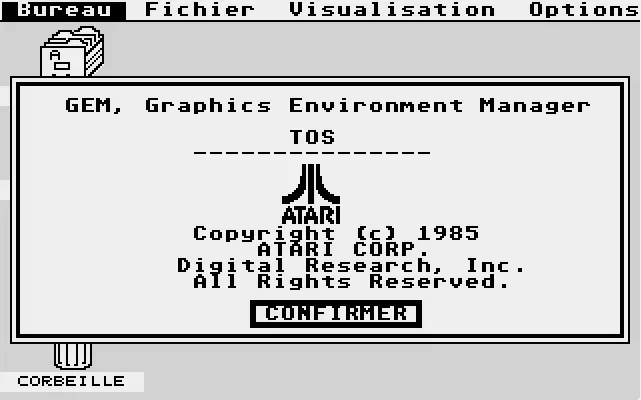
The ST’s operating system was named TOS (The Operating System), and it combined two parts: the GEM graphical environment from Digital Research, and a file system called GEMDOS. GEM (Graphics Environment Manager) had shipped from Digital Research in 1985, the same company behind CP/M and DR-DOS.
In September 1984 Atari’s team flew to Monterey to port GEM to the 68000 processor. At first it ran on top of CP/M-68K, but they soon realised they needed something more modern, with a hierarchical file system. That need produced GEMDOS. Here’s a detail worth a smile: because Atari had done most of the work on the 68000 version of GEM, it kept full rights to it. So the famous Apple lawsuit against Digital Research, the one that forced the MS-DOS version of GEM to be trimmed so it looked less like a Mac, never touched the Atari versions, which kept a far more Macintosh-like interface.
The Versions of TOS
The 520ST launch was rough. The first units shipped with only a minimal BIOS in a 16 KB ROM, and users had to load the full TOS (version 1.0, around 206 KB) from a floppy disk because of delays and miscalculations in ROM chip production. That early TOS 1.0 carried real bugs in file handling and had no hard disk support at all.
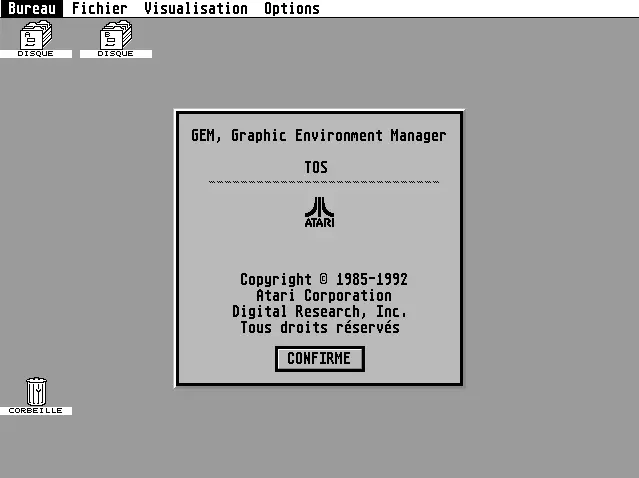
Between 1985 and 1992, seven years, each new generation of the ST brought a fresh TOS version. Version 2.06 was the last for the ST/STE and Mega ST. It added bug fixes, support for 1.44 MB floppies, a boot-time memory test, IDE hard disk booting, the Atari logo at startup and a much cleaner GEM GUI. In 1992, alongside its final machine the Falcon030, Atari released TOS 4, also known as MultiTOS. Version 4.04 was the company’s last official TOS.
The MIDI Ports: a Secret Weapon
What really set the Atari ST apart from every rival was its built-in MIDI ports, fitted as standard. No other home computer of the era shipped with them out of the box. That made it the favourite machine of recording studios and musicians for years: artists and producers used it to sequence synthesizers with a timing accuracy nothing else could match. Decades later, the ST still sat in many professional studios for its MIDI alone.
Curiosities and Legacy
Atari kept its naming scheme consistent to the end. When the TT030 workstation arrived in 1990, built around a 32 MHz 68030, the letters “TT” meant “Thirty-two/Thirty-two”, because that chip had 32-bit buses both inside and out. A year earlier, in 1989, the STE had appeared, a revision that brought the ST closer to the Amiga 500’s performance without quite overtaking it.
TOS didn’t die with Atari. In 1999, Caldera, heir to Digital Research, bought everything related to GEM and GEMDOS, hoping to use it in thin clients. The project never materialised, but they ended up releasing GEM and GEMDOS under the GPL license. Today, free projects such as EmuTOS keep the heritage of that fast, frugal system alive, in the same open-source tradition championed by the Linux kernel.