Talk to most people about free software and they think of Linux. But there’s another lineage, just as important and far older: BSD (Berkeley Software Distribution). It has worked away quietly for more than four decades, and odds are you’re using it right now without knowing: in the phone in your hand, the console in your living room, or the server streaming tonight’s movie to you.
Born in a university

In the late 1970s, the University of California, Berkeley received a copy of the UNIX source code from AT&T’s Bell Labs. A group of students and researchers, the famous CSRG (Computer Systems Research Group), set about improving it and shipping their patches and tools on tapes they called the “Berkeley Software Distribution”. The first one, 1BSD, dates from around 1978.
Those tapes gave us pieces we now take completely for granted. The most decisive was the TCP/IP implementation, popularized with 4.2BSD in 1983, which effectively became the foundation the internet was built on. And there’s plenty more everyday heritage: the vi editor, the C shell (csh) command interpreter, and the network sockets API, the mechanism still used by any program that talks to the network. A huge slice of modern computing’s plumbing was designed on that California campus.
The lawsuit that changed history
In the early 1990s, Berkeley made a perfectly sensible move: rewrite the parts of the system that still relied on AT&T’s proprietary code so it could release BSD with no legal strings attached. AT&T didn’t see it that way. In 1992, its subsidiary UNIX System Laboratories sued BSDi (the company selling a commercial version) and the university itself, alleging misuse of trade secrets.
The case, known as USL v. BSDi, was settled in February 1994. Technically the result amounted to almost nothing: of the 18,000 files in the distribution, only three had to be removed and a handful tweaked, which produced the clean 4.4BSD-Lite release. But the damage was done. Those two-plus years of legal limbo landed right when Linux was taking off. Plenty of historians argue that, had BSD not been stuck in court, the history of free software would have looked very different.
Three children with different personalities

The direct ancestor of everything that followed was 386BSD, a port to Intel 386 PCs that Lynne and William Jolitz released in 1992. That project, and the rows among its maintainers, gave us the three big BSDs we still use today:
- FreeBSD — the most popular. It was founded in 1993 by the coordinators of the 386BSD “patchkit” (among them Jordan Hubbard, Nate Williams and Rod Grimes). It chases performance and rock-solid reliability on servers and in data centers.
- NetBSD — also from 1993, born obsessed with portability. Its motto, “of course it runs NetBSD”, says it all: it runs on a staggering number of architectures, from a plain PC to hardware so odd it makes your head spin.
- OpenBSD — Theo de Raadt forked it from NetBSD in October 1995 after a falling-out with its team, releasing the first version in 1996. It’s the BSD fanatically devoted to security and line-by-line code auditing.
OpenSSH: OpenBSD’s gift to the planet
If one project shows BSD’s outsized impact, it’s OpenSSH. The OpenBSD team took the last freely licensed version of SSH and in December 1999 shipped it alongside OpenBSD 2.6. Today it’s the absolute standard for connecting securely to remote servers: virtually every Linux distribution uses it, from Debian and Ubuntu to Fedora and Arch, along with routers, phones and the overwhelming majority of the world’s servers. A piece of software born in BSD that is, somehow, both invisible and everywhere.
BSD is everywhere (even if you don’t see it)
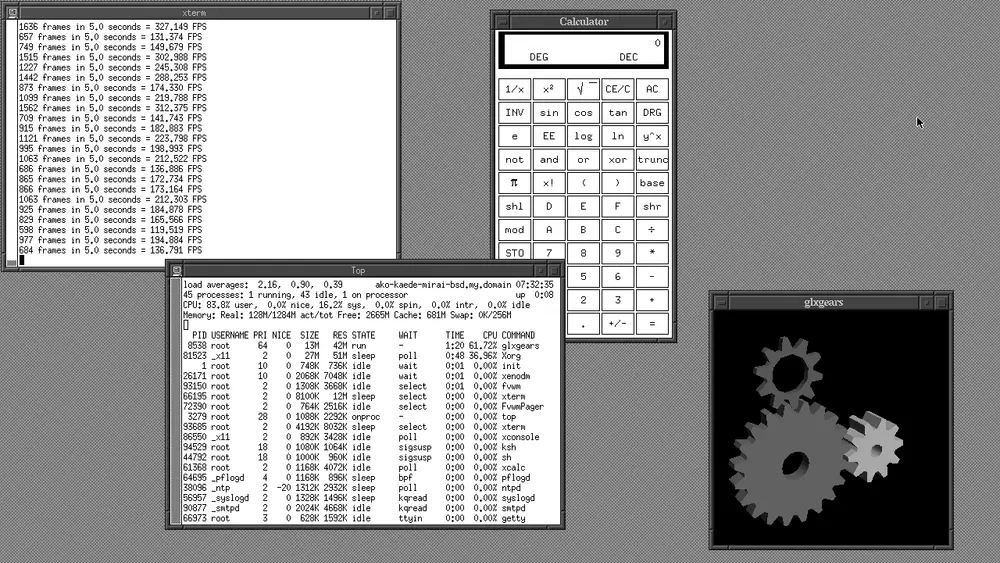
Here’s why BSD stays low-key yet quietly runs the show: its license is far more permissive than Linux’s GPL. It lets you take the code, modify it and bake it into a closed product with no obligation to publish your changes. That’s why you’ll find it in places you’d never guess:
- macOS and iOS have a kernel (Darwin/XNU) that carries plenty of BSD and FreeBSD code, a direct inheritance from NeXTSTEP.
- The PlayStation 4 and PlayStation 5 run on a FreeBSD-based system.
- Netflix serves its video traffic from its Open Connect network, built on FreeBSD, capable of pushing 800 Gb/s from a single server.
Next to the Linux ecosystem and its countless distributions, BSD makes far less noise. But for more than forty years it has been one of the most solid, elegant and influential pieces of all free software. Next time you connect over SSH, fire up your console or stream a show, remember there’s very likely a slice of Berkeley running underneath it all.