There was a time when trying out Linux meant repartitioning your hard drive, crossing your fingers and hoping you didn’t wipe Windows in the process. Knoppix put an end to that. You inserted a CD, rebooted and, a couple of minutes later, had a full Linux desktop running without touching a single partition. It was a small revolution, and it came from the mind of a German engineer named Klaus Knopper.
The Mind Behind Knoppix

Klaus Knopper is an electrical engineer, an independent consultant and an instructor at the Kaiserslautern University of Applied Sciences in Germany. In the late 1990s he was part of the LinuxTag team, Europe’s largest community-driven Linux expo, which he had helped co-found back in 1996.
His reasoning was simple yet brilliant. If rescue disks could already squeeze a shell and basic tools into barely 20 MB, why not fit a complete desktop and development environment onto a 700 MB CD? The first public release of Knoppix appeared on September 30, 2000, making it one of the first genuinely popular live distributions.
The Technical Magic: cloop and Hardware Detection
Knoppix’s secret came down to combining three ingredients. First, a compressed loopback filesystem driver called cloop, which decompresses data on the fly, letting more than 2 GB of software fit onto a 700 MB CD. Second, the packaging quality of Debian, on which the entire system was built. And third, the part people remember most, hardware detection and auto-configuration scripts that felt like sorcery.
At a time when getting your graphics card or sound to work on Linux could ruin your afternoon, Knoppix booted up and just worked. The system loaded from the CD and decompressed into a RAM drive, leaving the hard disk untouched. That made it the Swiss Army knife of every technician: recovering data, rescuing a broken system or demoing Linux without installing a thing.
Key Releases Over the Years
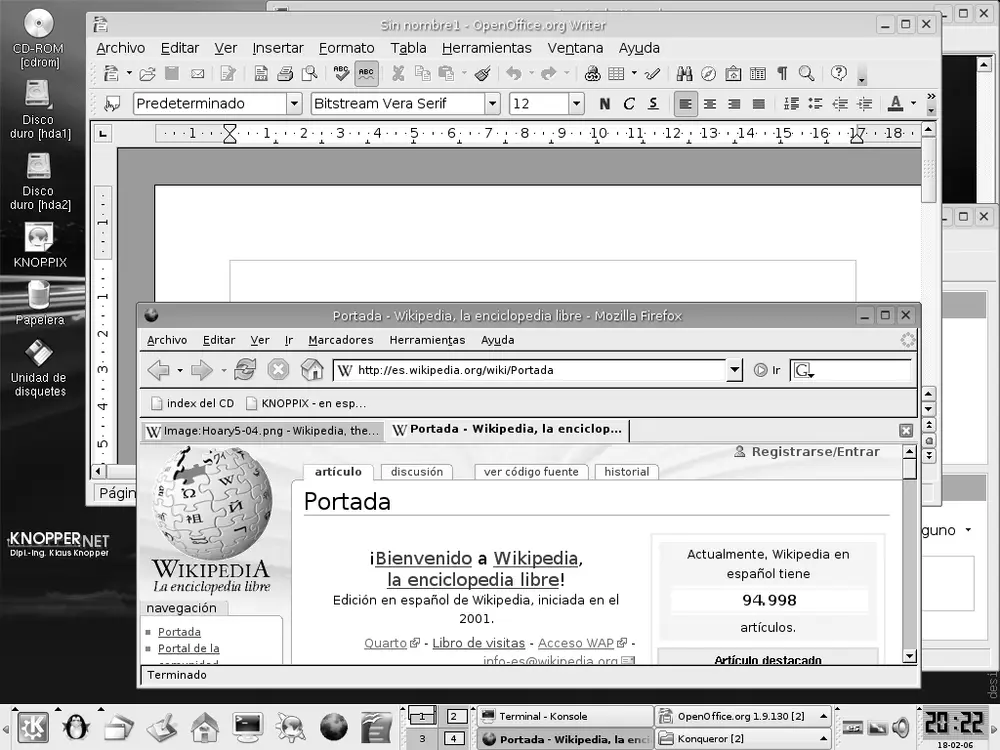
Knoppix has enjoyed a long, well-documented life:
- Versions 4.x and 5.x (2005–2007): the project split into a DVD “maxi” edition packed with several gigabytes of software, and a lighter CD edition.
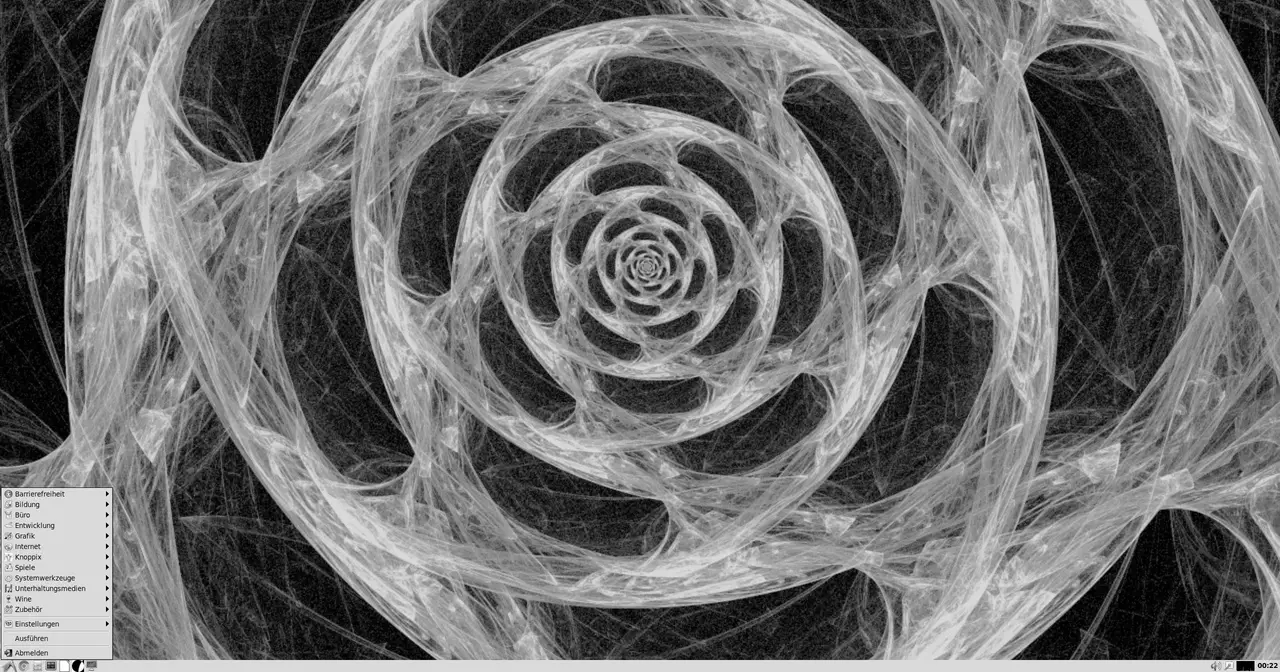
- 6.x (2009): a near-complete rebuild that adopted LXDE as the default desktop, chasing lightness and fast boot times.
- 7.x (2012–2015): the last CD-only release was 7.2 in June 2013; from then on the format shifted toward DVD and USB flash drives.
- 8.x (2017–2019): introduced dual-boot capability and a choice of desktop between LXDE, KDE and GNOME.
- 9.x (2020–2022): version 9.3 was released in June 2022.
Today Knoppix ships both in a classic CD edition and a DVD “Maxi” edition, always in German and English, faithful to its roots.
A Curiosity With a Name: ADRIANE
One of the project’s most heartwarming stories is ADRIANE Knoppix, a variant released in 2007 designed for blind and visually impaired users and fully usable without a screen. The name is no accident: it is a backronym for Audio Desktop Reference Implementation And Networking Environment, but it is also the name of Adriane Knopper, Klaus’s wife. Adriane is visually impaired and personally helped develop this edition. Few distributions can boast a tribute so personal written into their own code.
The Legacy of Knoppix
It is hard to overstate Knoppix’s influence. It laid the groundwork for the live concept that almost everyone in the Linux world later adopted: today nearly every Linux installer, from Ubuntu to Fedora, boots first into a live mode before installing, an idea Knoppix popularized. Its codebase also spawned famous derivatives such as Kanotix, KnoppMyth and the early security tooling that would later inspire penetration-testing distributions.
A direct descendant of Debian and a contemporary of the desktop-distro boom that challenged veterans like Slackware, Knoppix proved that Linux could be accessible, portable and, above all, that it could be tried without fear. More than two decades on, Klaus Knopper still maintains it. A reminder that great ideas can sometimes fit on a single disc.