Boot a Windows 11 machine today and you are running code whose lineage traces all the way back to 1993. That year Microsoft released Windows NT 3.1, an operating system built entirely from scratch that had nothing to do with old MS-DOS or the early graphical versions of Windows. It was a huge gamble: a professional, solid, 32-bit kernel designed to take on Unix in workstations and servers. This is its story.
A Legendary Team Joins Microsoft
The story of Windows NT begins outside Microsoft. Throughout 1988, a group of engineers led by Dave Cutler left Digital Equipment Corporation (DEC) after the company cancelled its PRISM and MICA projects. Cutler was a giant of the field. He had designed the VMS operating system for DEC’s VAX minicomputers, as well as RSX-11 and VAXELN. Microsoft hired him along with his team and set up what became the Portable Systems Group.
The initial assignment was not to create a new Windows but a portable, 32-bit version of OS/2, the system Microsoft was then developing jointly with IBM. The project went by the name “NT OS/2” and aimed to support several “personalities”: the OS/2 APIs, a POSIX layer to qualify for US government contracts, and compatibility with applications that already existed.
From OS/2 to Windows
Everything changed with the runaway success of Windows 3.0 in 1990. Microsoft watched how well the Windows graphical interface sold and pivoted: NT would no longer be a portable OS/2 but a 32-bit version of Windows. That decision weighed heavily in the breakup of the Microsoft-IBM alliance, after which IBM went its own way with OS/2.
The new system inherited much of Cutler’s DEC background. NT’s design draws directly on his work with VMS and with MICA, the object-based system that never shipped. No surprise, then, that someone joked “VMS + one letter = WNT”.
Windows NT 3.1: The 1993 Debut
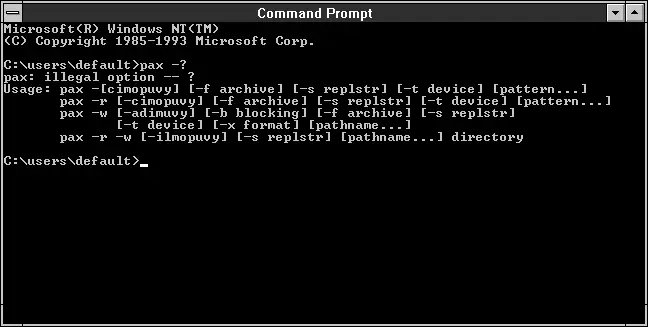
Windows NT 3.1 launched on July 27, 1993. It wore the familiar Program Manager interface of Windows 3.1, yet underneath it was a different world: a kernel running in supervisor mode (ring 0) with independent user-mode subsystems. It shipped with the brand-new 32-bit Win32 API, an OS/2 1.3 text-mode environment and a POSIX subsystem. From then on, the older 16-bit API became known as Win16.
Another major addition was NTFS, a journaling file system designed to get past the security, scalability and reliability limits of FAT. NTFS remains the default file system of Windows three decades later. NT 3.1 was also cross-platform from birth: it ran on Intel i386 and MIPS R4000 processors, with portability as a core design philosophy from day one.
The Versions That Cemented NT
After the debut, improvements arrived quickly. Windows NT 3.5 (1994) tuned performance and memory use, one of the early criticisms. Windows NT 3.51 (1995) refined the system further and added support for the PowerPC architecture.
The decisive leap was Windows NT 4.0, released on August 24, 1996. It adopted the Windows 95 Explorer shell, with its Start menu and modern desktop, without giving up the rock-solid NT kernel. This brought NT closer to the mainstream and cemented it in the professional world.
The line peaked with Windows 2000, which introduced Active Directory and brought NTFS to a consumer-facing release for the first time, and above all with Windows XP (2001), which finally merged the home and professional families onto the NT kernel. Ever since, every modern Windows release —including today’s Windows and Windows Server— descends from that 1993 code.
Real Windows NT Curiosities

The eternal question is what “NT” actually stands for. Officially, Microsoft always said “New Technology”. But original engineers like Mark Lucovsky and Dave Plummer have explained that the name came from the processor it was first designed for: the Intel i860, code-named N10, read aloud as “N-Ten”. The i860 was never actually used, since development jumped to MIPS and ended up on the Intel 386, but the name stuck. To build internal test boards, the team even put together i860 machines code-named “Dazzle” and “Frazzle”.
That portable, modular design proved so sound that it laid the foundations of Windows for more than thirty years. If you enjoy robust systems from that era, compare NT with its closest rival, OS/2, and with the professional Unix systems such as Solaris and AIX that NT challenged on 1990s servers.