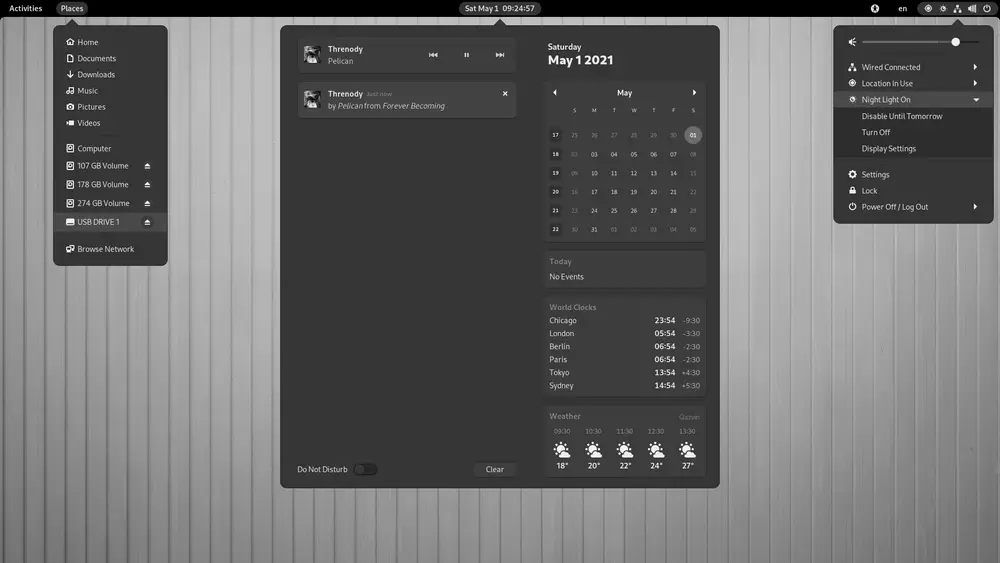
Few projects have shaped the everyday Linux experience as deeply as GNOME. If you have ever booted a machine running Fedora, browsed the menus of Debian, or worked on a laptop with Ubuntu, chances are you were looking at GNOME without realising it. Behind that clean, minimalist desktop sits nearly three decades of technical decisions, heated arguments, and one very clear conviction: free software had to be free all the way down.
A birth driven by freedom
GNOME was founded on 15 August 1997 by Miguel de Icaza and Federico Mena Quintero, two young developers connected to the National Autonomous University of Mexico. The name stands for GNU Network Object Model Environment, which marked its place within the GNU project from day one.
The trigger was a matter of principle. A free graphical desktop called KDE already existed, but it was built on Qt, a toolkit that at the time was not released under a free licence. For Icaza and Mena, an operating system that aspired to be fully free could not depend on a proprietary component sitting at its very core. So they built a brand-new desktop from scratch, based on GTK, the toolkit that had grown out of the GIMP image editor and was distributed under the GNU LGPL.
GNOME 1: laying the foundations
The first stable release, GNOME 1.0, was unveiled in March 1999 at the Linux World Expo in San Jose, California. It was a functional but still rough desktop, with a panel, launchers, and a growing set of native applications. What mattered was not its polish but its message: a fully free alternative finally existed for those unwilling to compromise on Qt.
Those early years were marked by chaotic, enthusiastic growth. Distributions began adopting it, developers joined in droves, and it soon became clear that the project needed a structure to sustain it beyond pure volunteering.
The GNOME Foundation and the age of stability
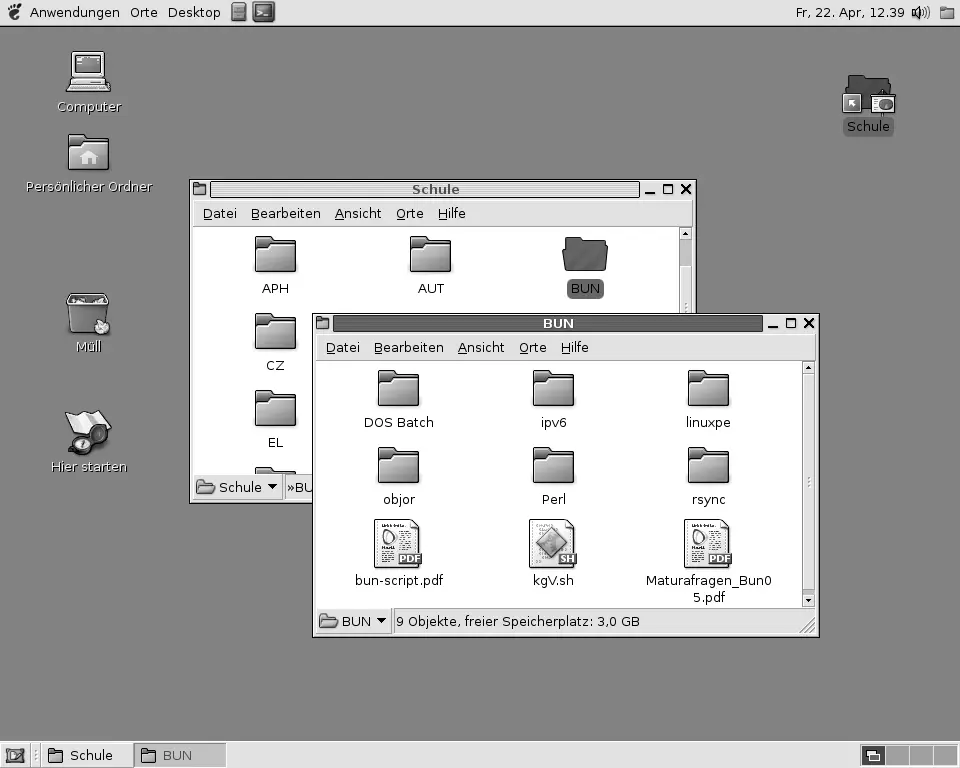
In 2000 the GNOME Foundation was created, a non-profit tasked with coordinating development, managing the brand, and acting as a bridge to industry. Companies such as Red Hat and Sun Microsystems invested heavily and contributed resources and professional developers.
That backing paid off with GNOME 2, released in 2002, which became synonymous with the serious Linux desktop for almost a decade. Its classic interface, with two panels, drop-down menus, and a “things should just work” philosophy, won over technical and novice users alike. Distributions like Debian, Ubuntu, and early versions of openSUSE shipped it as their default environment, and GNOME became the public face of desktop Linux.
GNOME 3 and the great controversy
In April 2011 everything changed with the launch of GNOME 3 and its new interface, GNOME Shell. The team chose to break with the traditional desktop metaphor in favour of something more abstract: a centralised activities overview, minimalist window management, and a drastic simplification of configuration options. The minimise and maximise buttons disappeared, and many settings were tucked away.
The reaction was immediate and deeply divided. A large part of the community felt that control over their own desktop had been taken from them. Linus Torvalds himself publicly voiced his disapproval, famously calling the 3.4 release a “total user experience design failure.” The discontent ran so deep that it sparked two historic forks: MATE, born in August 2011 to preserve the classic GNOME 2 experience, and Cinnamon, derived from the GNOME 3 codebase and popularised by Linux Mint. Users gained more options, even if the price was a fractured community.
Maturity and reinvention
Over time, GNOME Shell smoothed out its rough edges, and many of its critics eventually surrendered to its comfort. The project kept evolving with confidence. GNOME 40, released in March 2021, completely reorganised the activities overview with horizontally arranged workspaces, while GNOME 42, in March 2022, introduced a native dark mode and the new Libadwaita component library to unify the look of applications.
Today GNOME is the default desktop across much of the Linux world, present in Fedora, Ubuntu, Debian, and countless other distributions. From that 1997 reaction against a non-free licence has grown one of the most influential free software projects in history: a desktop that still champions the idea that control over our digital tools is, in itself, a form of freedom.