Alongside GNOME, KDE is one of the two great desktop environments that have shaped how millions of people use Linux every day. Behind its polished looks and its reputation as an endlessly configurable desktop sits a story that spans almost three decades. There’s plenty of innovation in it, a notorious licensing fight and a community that never stopped growing. Let’s walk through it.
The announcement that started it all in 1996
It all began on 14 October 1996. Matthias Ettrich, then a student at the Eberhard Karls University of Tübingen in Germany, posted a message proposing a brand-new desktop environment. His frustration made sense: the Unix systems of the time had powerful graphical applications, but each one looked and behaved its own way. Nothing felt consistent.
Ettrich wasn’t proposing to bundle a handful of programs together. He wanted a complete desktop where everything looked, felt and worked the same. That was the start of the K Desktop Environment, a project that set out to give Linux and Unix an experience as integrated as the one you got on Windows or Mac OS.
The choice of Qt and the big controversy
To build KDE, Ettrich went with Qt, the graphical toolkit made by the Norwegian company Trolltech. It was excellent, modern and very productive, but it came with a serious catch for the free software world: at the time, Qt was proprietary.
That set off an intense controversy. For much of the community, building a free desktop on top of a non-free foundation was an unacceptable contradiction. The tension ran so high that it helped push GNOME forward as an alternative built on fully free licences.
The conflict was eventually settled. In 2000, Trolltech released Qt under the GPL, finally aligning the toolkit with free software principles. To make sure that outcome held, the KDE Free Qt Foundation had already been set up back in 1998. Its job is to guarantee that Qt stays available for free software development now and in the future, whatever happens to the company that owns it.
From version 1.0 to the KDE 4 era
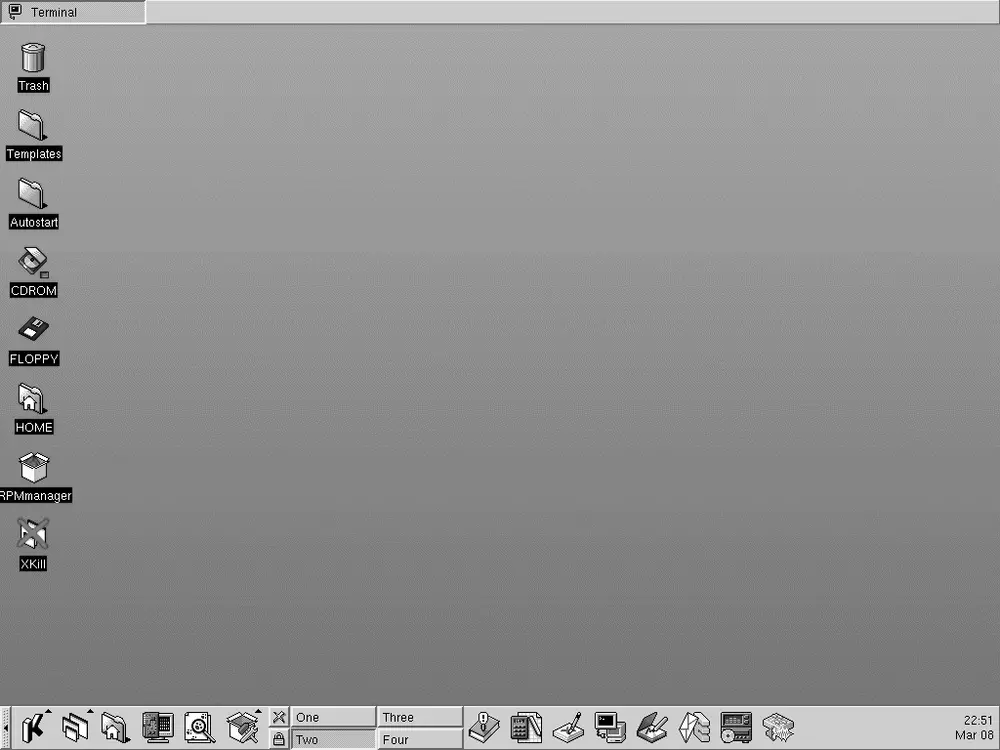
The first stable release, KDE 1.0, landed in 1998 and proved the idea worked: a coherent desktop with its own window manager, panel and a set of integrated applications. Each new generation refined the formula, and that eventually led to the KDE 4 series, which brought in a completely new architecture built on technologies such as Plasma, Phonon and Akonadi.
KDE 4 was ambitious and groundbreaking. Its earliest versions got a rough reception because they were unstable at first, but it matured over time and laid the technical foundation for everything that came after. During these years, KDE became the default desktop on flagship distributions such as openSUSE, historically one of its strongest champions.
Plasma 5: separation and modernisation
July 2014 brought a real shift in philosophy. The project split its components cleanly into two: the KDE Frameworks 5, a set of modular libraries organised into tiers, and Plasma 5, the workspace or desktop itself, built on Qt 5.
Plasma 5 introduced the Breeze visual theme and pushed for convergence across devices. Its great strength was pairing elegance with almost unlimited customisation: panels, widgets, effects, shortcuts and themes you can tune down to the smallest detail. That flexibility made it hugely popular on distributions aimed at newcomers and power users alike, such as Manjaro, which ships one of the most polished KDE editions around.
Plasma 6 and the leap to Qt 6 and Wayland
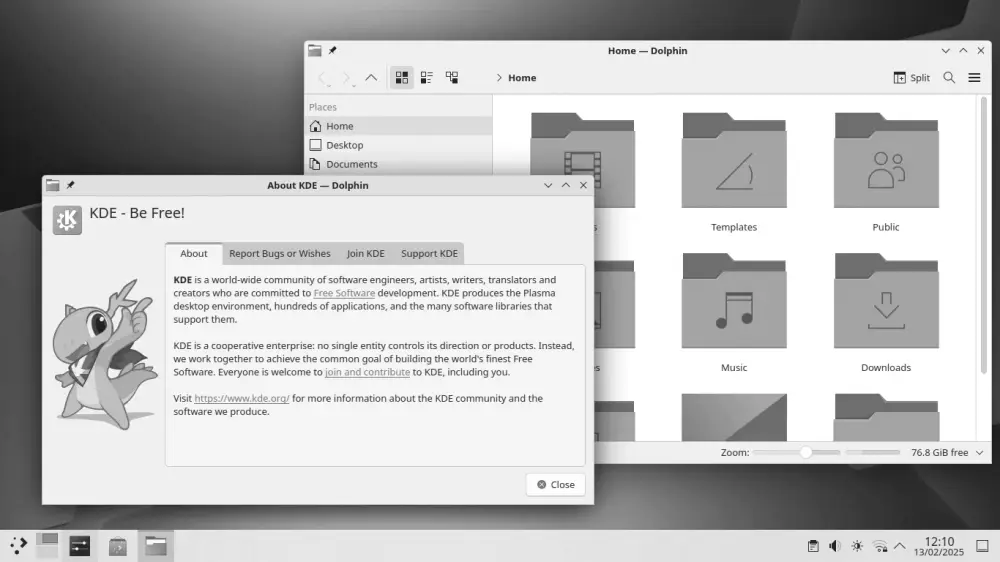
On 28 February 2024, KDE released Plasma 6, one of the most significant transitions in its history. The version delivered a double technological leap: the migration to Qt 6 and the adoption of Wayland as the default graphics platform, bringing the desktop’s foundations up to date for the years ahead.
Plasma 6 keeps Ettrich’s original promise of consistency and freedom of customisation, but tailored to today’s needs. You’ll find it across countless systems, from the KDE Spin of Fedora to virtually any modern distribution.
So much more than a desktop
Reducing KDE to its desktop alone would be unfair. Over the years, the community has produced top-tier applications that have grown well beyond the environment itself: Krita, a professional digital painting program that illustrators worldwide admire, and Kdenlive, one of the most complete free non-linear video editors you’ll find. Both show that KDE is far more than a way to organise windows. It’s a complete free software ecosystem.
Almost thirty years after that message on a mailing list, KDE stays faithful to its founding spirit: giving anyone, on any distribution, a free, coherent and deeply customisable desktop.