Very few Linux distributions can claim more than three decades of continuous life. openSUSE and its enterprise sibling are direct heirs of one of the oldest Linux companies in the world. The story began in a Germany where Linux still fit on a stack of floppy disks. If you have ever wondered where the green chameleon came from, here is its journey.
Four Students and a Name That Honors Zuse
It all started on September 2, 1992, in Nuremberg. Roland Dyroff, Burchard Steinbild, Hubert Mantel and Thomas Fehr founded a small software company and named it S.u.S.E., an acronym for Software- und System-Entwicklung (“software and systems development”). The name was also a nod to Konrad Zuse, the German engineer who built one of the first programmable computers in history.
The original plan was not to create a distribution but to offer UNIX consultancy. The team soon decided to bet on Linux instead, an operating system that at the time was barely a year into its public life. That decision made S.u.S.E. one of the very first companies on the planet to build a business around free software.
From Slackware to Its Own Distribution
The company’s first product was an extension of Slackware, shipped on 40 floppy disks. Working alongside Patrick Volkerding, the creator of Slackware, the founders translated the installation scripts into German, which led in 1994 to S.u.S.E. Linux 1.0.
That dependence on Slackware did not last long. In early 1994 S.u.S.E. released its first distribution based on Jurix, a project by Florian La Roche, marking the start of its own technical foundation. From there the German distribution gradually developed its own identity, much like other great families such as Debian or Red Hat Enterprise Linux did over time.
YaST: The Tool That Set It Apart
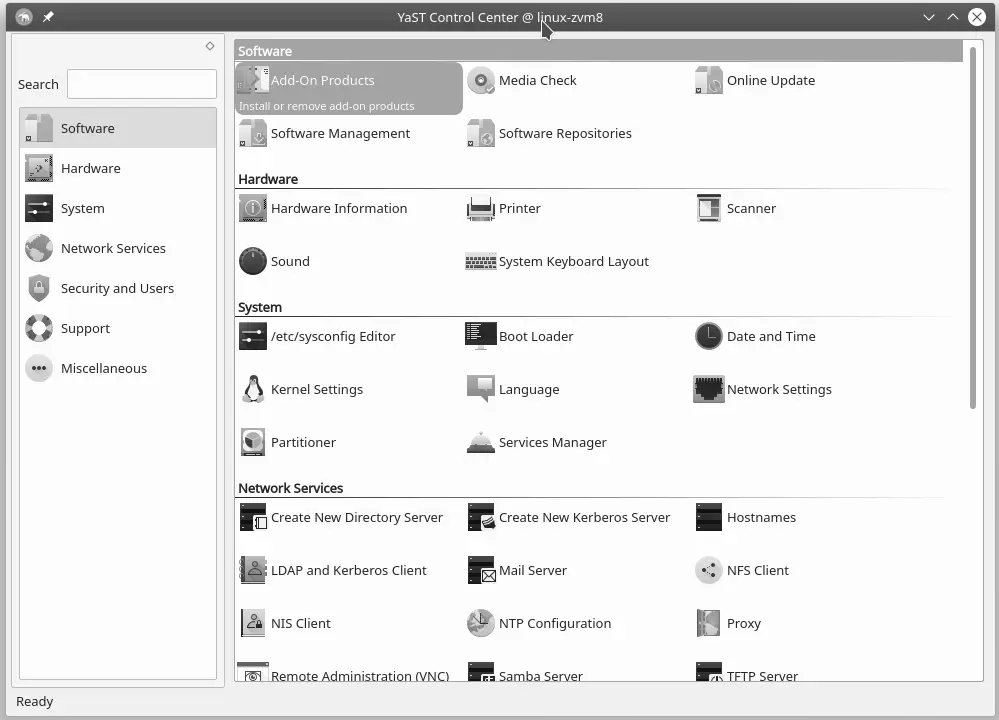
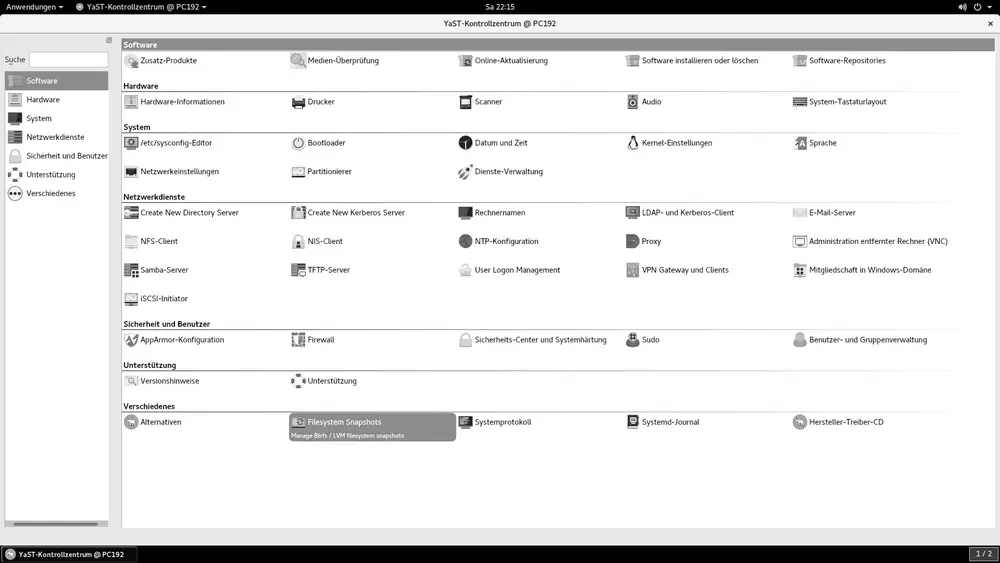
If anything has defined SUSE for decades, it is YaST (Yet another Setup Tool), its centralized administration panel. Where other distributions forced users to hand-edit configuration files, YaST let you manage partitions, packages, networking, users and services from a single coherent interface, graphical and text-based alike.
That “everything configurable from one place” philosophy is still one of the hallmarks that separates SUSE from more minimalist options such as Arch Linux or Gentoo.
Novell’s Acquisition and the Birth of openSUSE
On November 4, 2003, Novell announced the acquisition of SuSE Linux AG for $210 million, a deal that closed in January 2004. The move placed SUSE at the heart of the corporate Linux battle against Red Hat’s model.
To make sure the community would not lose access to a free version, in August 2005 Novell announced the launch of the openSUSE project. This gave birth to an openly developed distribution, with its trademark green chameleon, where anyone could take part. The pattern echoes the relationship between RHEL and community projects such as Fedora or, later, Rocky Linux and AlmaLinux.
Leap and Tumbleweed: Stability or the Cutting Edge
Since late 2015, openSUSE has split into two major editions covering opposite needs. Leap is the conservative fixed-release version. It shares its base with SUSE Linux Enterprise and prioritizes stability, which makes it ideal for servers and workstations. Tumbleweed takes the other road: a rolling-release distribution that continuously integrates the latest stable software. The project was started in November 2010 by Greg Kroah-Hartman, one of the most important developers of the Linux kernel.
This dual approach lets a single project serve both those who want an unchanging system for years and those who want the very latest. In other families that calls for entirely separate distributions.
SLES and Today’s SUSE
Alongside openSUSE, the company maintains its commercial product: SUSE Linux Enterprise Server, or SLES, introduced in 2001 and widely deployed across large infrastructures, especially in SAP and mainframe environments. SLES and openSUSE Leap share a common base, so the community and the business feed into each other.
The company’s ownership has changed hands several times: after Novell came Attachmate in 2011, then Micro Focus in 2014, and finally the investment firm EQT bought it in 2019, restoring its independence. In 2021 SUSE went public on the Frankfurt Stock Exchange, though it returned to private ownership in 2023.
More than thirty years after those 40 floppy disks, the chameleon is still alive, free and constantly evolving. If you want to see it for yourself, start by downloading openSUSE and find out why it earned its place among the most respected distributions in the history of Linux.