
Some distributions boast about being modern. Slackware boasts about having character. Slackware sits firmly in the second camp: born in 1993, it is the oldest Linux distribution still in active development. Dozens of projects have come and gone around it, yet it has kept its way of understanding an operating system almost untouched. Here is how it got there.
A university project that reshaped the landscape
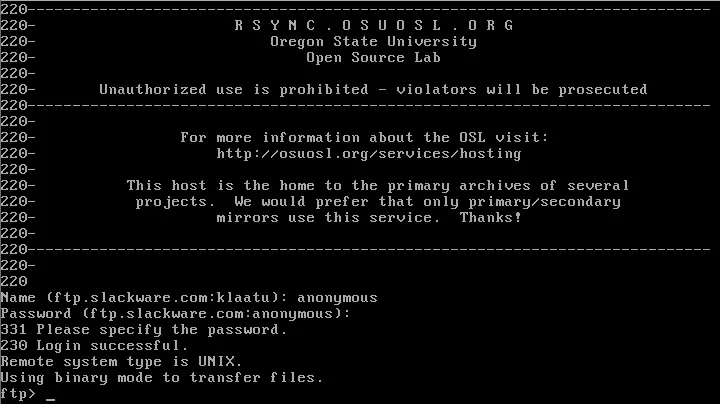
In late 1992, Patrick Volkerding was a student at Moorhead State University who needed a LISP interpreter for a class assignment. He found that CLISP ran on Linux and downloaded SLS (Softlanding Linux System), the most popular distribution of the era and the first to ship more than just the kernel: it bundled X11, TCP/IP networking, UUCP and GNU Emacs.
Volkerding started fixing bugs and tidying up that system for his own use. When he posted a message asking “Anyone want an SLS-like 0.99pl11A system?”, the response was so enthusiastic that he packaged it and released it. Version 1.00 appeared on July 17, 1993, spread across twenty-four 3½-inch floppy disks. It became the first Linux distribution to reach truly widespread use.
From SLS to its own identity
Slackware started from SLS, but it soon charted its own course. Volkerding wanted a coherent, predictable system that stayed true to UNIX tradition, free of the automation layers that, in his view, hide how the system actually works. That choice shaped the distribution’s character for decades.
The name, with its playful nod to the “Discordian” subculture and the idea of “slack,” sat in sharp contrast to the deeply serious engineering underneath. Slackware never tried to be the easiest distro. It set out to be the cleanest and most transparent.
The philosophy: UNIX-style simplicity
Slackware’s guiding principle is simplicity, but the designer’s kind, not the beginner’s. Here “simple” means the system adds no hidden complexity: there are no configuration tools rewriting your files, and no magic layers between you and the machine.
You can see it in its BSD-style init system, where each runlevel is handled by a single rc file rather than the many directories and scripts of the System V style used by distributions such as Debian or Ubuntu. The result is a boot process anyone can read and edit in a text editor. Slackware never adopted systemd either, sticking with its traditional scheme while many other distributions migrated.
pkgtool: package management without automatic dependencies
The thing that surprises newcomers from Fedora or any apt-based system the most is that Slackware does not resolve dependencies for you. Its tools pkgtool, installpkg, removepkg and upgradepkg install exactly what you ask for, nothing more.
This is no oversight. It is a deliberate philosophical choice. Volkerding has argued that automatic resolution can drag users into the dreaded “dependency hell” of version conflicts and circular dependencies. Slackware’s answer is to hand the administrator full control and to assume that installing the complete distribution (the recommended approach) makes most dependency headaches disappear, because the whole set is designed as one cohesive unit. For anyone who wants convenience, third-party tools like slackpkg or slapt-get exist, but they have never been mandatory.
Legendary stability and an unhurried pace
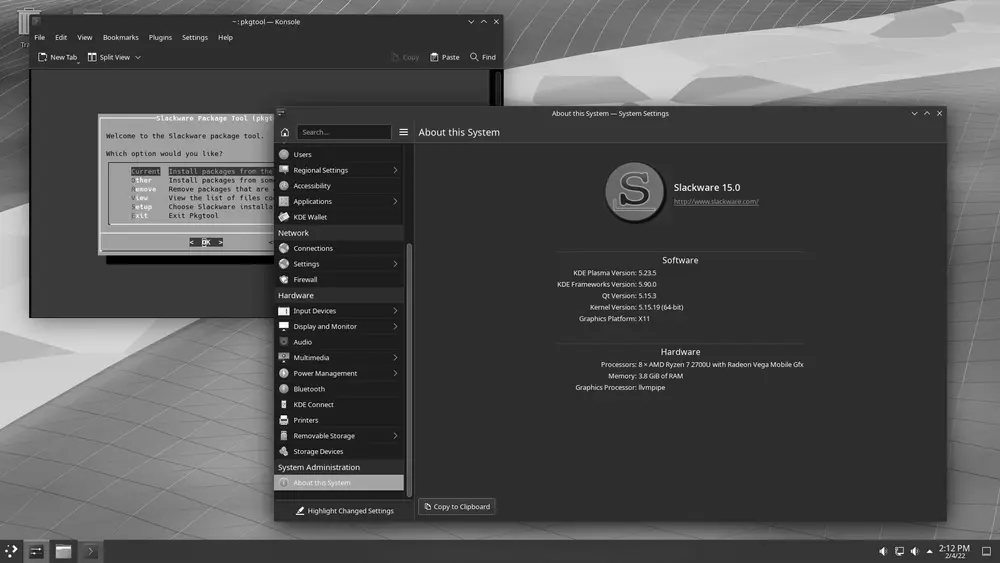
Slackware is famous for its conservatism. It does not chase the latest version of every package, only the ones that have proven solid. That makes it a much-loved choice for servers and environments where reliability matters more than novelty.
Its release calendar says it all: version 15.0 arrived on February 2, 2022, more than five years after 14.2, bringing the Linux 5.15 kernel, KDE Plasma 5.23 and Xfce 4.16. Where others ship every six months, Slackware ships when it is ready. That cadence frustrates some people, and it is exactly what its followers value.
Its mark on other distributions
Slackware’s influence reaches well beyond its own users. The earliest versions of SUSE, today reborn as openSUSE and the enterprise-grade SLES, were built directly on Slackware. That lineage places it at the root of an entire family of heavyweight European distributions. It has also inspired projects that share its minimalist, hands-on spirit, such as Gentoo or Arch, where the user sits back at the center of every decision.
Why Slackware still matters
In a world obsessed with automating every step, Slackware stands by an idea that never goes out of style: understanding your own system. It is not the most comfortable distribution to start with, and it certainly does not compete on ease of use with Linux Mint or the big desktop options, but it gives you something hard to find: complete transparency and more than three decades of continuity.
Slackware does not need to reinvent itself to stay relevant. The fact that it is still here, faithful to the principles of 1993, is the best proof that simplicity done right ages remarkably well.